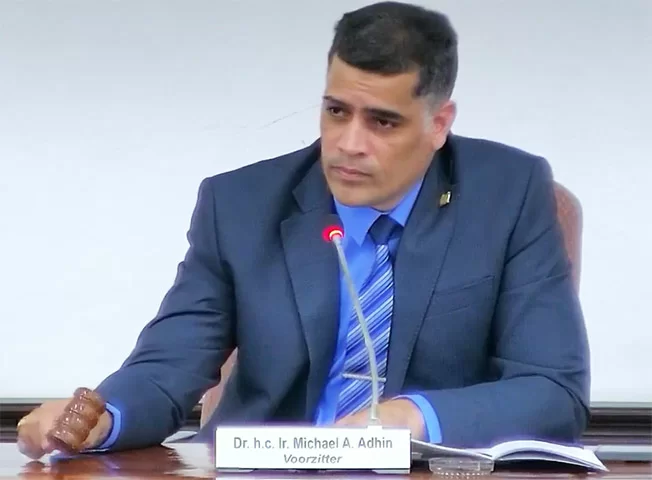
A scheduled plenary session of Suriname’s De Nationale Assemblee to debate four high-stakes judicial reform bills collapsed Thursday after failing to meet the minimum attendance requirement for a legally valid meeting, forcing Assembly Speaker Ashwin Adhin to adjourn the gathering indefinitely. The breakdown of the session has laid bare deep internal rifts within the country’s ruling coalition over the proposed legislative changes.
Under Assembly rules, at least 26 sitting members must be present to open a formal, binding debate. When roll was called, just 21 of the 34 members of the governing coalition showed up for the vote, falling far short of the required threshold. The absences were particularly stark among the six-member ABOP faction: only party representative Stanley Betterson registered his attendance. While all members of the large VHP faction were present in the parliamentary building, none signed the official attendance register in a coordinated show of opposition to the bill package.
Originally convened at 1 p.m. local time, the session was ultimately dissolved at approximately 4:30 p.m. after hours of waiting for absent members to arrive. The mass absence of ABOP lawmakers made existing tensions within the ruling coalition over the judicial reform legislation impossible to ignore. In remarks following the adjournment, Adhin noted that negotiations over the four bills remain ongoing, adding that consultations with faction leaders and further coordination with the Suriname Court of Justice will be held to get the legislative process back on track. No new date or time for resuming the debate has been set, with the session adjourned until further notice.
Speaking to local outlet Starnieuws, NDP faction leader Rabin Parmessar clarified that a number of NDP and NPS lawmakers are currently traveling abroad, which contributed to the attendance shortfall. He added that the VHP, the coalition’s largest bloc, still holds formal objections to key provisions of the legislative package, particularly the planned phase-out of specific institutional provisions within the national judiciary. According to Parmessar, the VHP has called for discussions on alternative policy frameworks and new transition arrangements for the reform. Follow-up talks to resolve these outstanding disagreements are scheduled for Friday, where participating parties will conduct detailed cost and impact projections for proposed amendments to the bills.