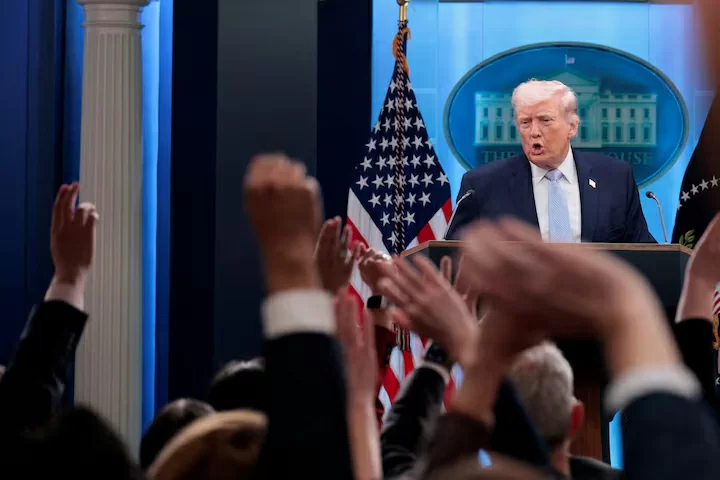
Just hours after the United States and Iran announced a landmark two-week ceasefire in their long-running escalating conflict, U.S. President Donald Trump has sent shockwaves through the international community with a sharp new threat: immediate 50% import tariffs on all goods from any nation that supplies military weapons to Iran.
The announcement, made via Trump’s own social media platform, made clear no exceptions would be granted to the measure, in an explicit warning to major powers China and Russia, both of which have a history of supporting Iran’s military capacity building through past deliveries of missile technology and air defense systems. While both Beijing and Moscow have repeatedly denied supplying new weaponry to Iran in recent months, unsubstantiated accusations of ongoing military assistance to Tehran continue to circulate against Russia.
A key legal caveat complicates Trump’s ability to implement the proposed tariffs, however. Back in February, the U.S. Supreme Court rolled back part of the broad trade authority the president had previously claimed to impose sweeping tariffs, significantly limiting his executive power to enact such measures. As a result, trade experts widely predict Trump will attempt to push the new restrictions through alternative trade policy mechanisms rather than relying on his earlier executive authority.
The tariff threat has already put new strain on U.S.-China relations, one of the world’s most consequential bilateral trade partnerships. Policy analysts note that despite the hardline rhetoric directed at Beijing over the Iran issue, Trump is likely eager to avoid derailing his planned upcoming visit to China, leaving his next moves uncertain. On Thursday morning, China’s Ministry of Defense rejected accusations that Chinese entities have supplied Iran with advanced chip manufacturing equipment or satellite imagery, reiterating that Beijing maintains a neutral, peaceful stance on the Iran conflict and has repeatedly called for all parties to resolve disputes through diplomatic dialogue.
The newly announced two-week ceasefire between the U.S. and Iran remains fragile, with both sides continuing to frame themselves as victors of the recent open conflict that sent global oil prices soaring and disrupted international financial markets. As a core condition of the truce, Iran has agreed to temporarily reopen the Strait of Hormuz, the vital chokepoint through which roughly a fifth of the world’s daily oil supplies pass.
Tehran has put forward a 10-point framework for reaching a permanent end to hostilities, with key demands including the full lifting of international sanctions on Iran, permanent Iranian sovereignty and control over the Strait of Hormuz, and the complete withdrawal of U.S. military forces from the broader Middle East region. U.S. negotiators have called the Iranian plan “generally feasible” but noted that several core provisions remain unacceptable to Washington.
Formal peace negotiations between U.S. and Iranian delegations are scheduled to kick off Friday in Islamabad, Pakistan, with the Pakistani government serving as the official neutral mediator. Both sides have publicly stated their goal of reaching a durable, long-term peace agreement within the 14-day ceasefire window.
The truce faces an early major test, however. On Thursday, Iranian President Masoud Pezeshkian condemned the latest large-scale Israeli airstrikes on Lebanon, saying the attacks directly violate the newly signed ceasefire agreement and would render upcoming peace talks meaningless. He added that Iran would not abandon the Lebanese people in the face of the assault. Pezeshkian’s remarks came after the deadliest single day of Israeli attacks on Lebanon since the outbreak of conflict with Hezbollah last month, which killed more than 250 people on Wednesday alone.
Beyond the geopolitical tensions, Trump’s new tariff threat represents a continuation of his administration’s strategy of using trade measures as a tool of geopolitical pressure on Iran’s global partners. If implemented, the new tariffs would further complicate already strained global trade relations that have been roiled by repeated tariff disputes and sanctions in recent years.
U.S. imports from China have already fallen dramatically since the start of Trump’s first trade war with Beijing, dropping from a 2018 peak of $538.5 billion to just $308.4 billion in 2025. Imports from Russia have also plummeted following sweeping sanctions imposed after the 2022 invasion of Ukraine, though certain key strategic commodities such as palladium still enter the U.S. market. The U.S. Chamber of Commerce is currently preparing new additional tariffs on Russian palladium imports, in response to alleged dumping practices by Russian exporters.