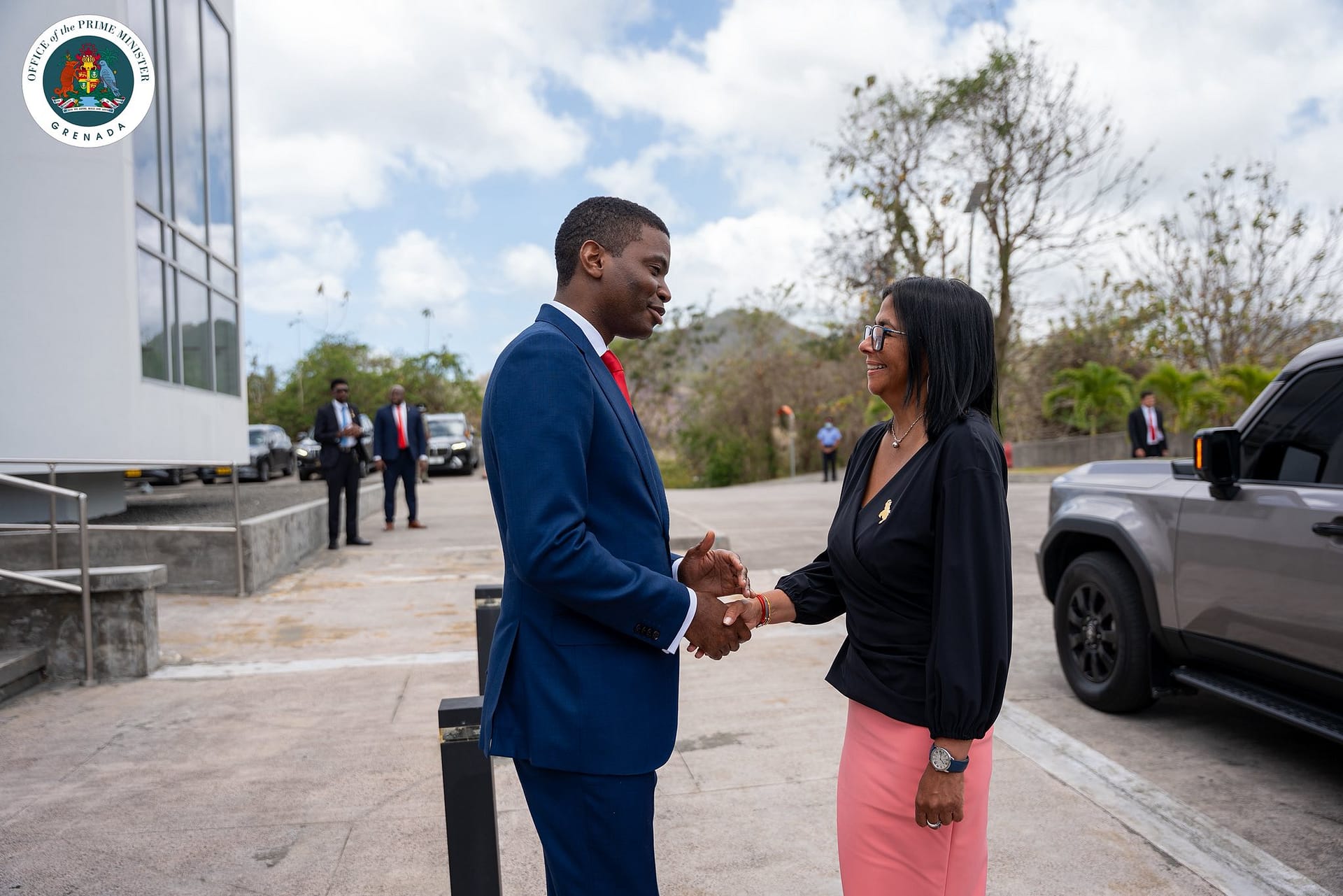
Against a backdrop of growing regional collaboration across the Caribbean basin, Venezuelan Acting President Delcy Rodríguez’s official visit to Grenada has emerged as a landmark moment for deepening bilateral bonds and advancing the vision of Bolivarian Diplomacy of Peace, a foreign policy framework centered on cross-regional unity and shared, inclusive development. This trip builds directly on the momentum generated by Grenadian Prime Minister Dickon Mitchell’s 2025 visit to Caracas, where the two nations signed a foundational bilateral cooperation roadmap, and aims to lock in progress on the mutually beneficial commitments laid out in that agreement.
Upon Rodríguez’s arrival at Maurice Bishop International Airport in St. George’s, Grenadian government officials greeted the Venezuelan delegation with full ceremonial honors, a gesture that highlighted the long-standing ties of solidarity and mutual respect that have defined relations between the two countries since their formal establishment of diplomatic ties in 1977. Over the past four decades, diplomatic engagement has accelerated steadily, with growing mutual trust, consistent high-level exchanges, and aligned commitments to regional stability and equitable socio-economic progress shaping the partnership. This is not Rodríguez’s first official engagement with Grenada: in April 2024, while serving as Venezuela’s Executive Vice President, she joined Grenadian citizens for celebrations marking the 50th anniversary of the nation’s independence, underscoring the deep personal and political connections that anchor the bilateral relationship.
As Acting President, Rodríguez framed the visit as an opportunity to consolidate comprehensive, win-win cooperation between the two nations, reaffirming Caracas’ unwavering commitment to building mutually respectful relationships that deliver tangible improvements to the quality of life for both Venezuelan and Grenadian citizens. This focus on shared benefit and collective progress is a core tenet of Venezuela’s Caribbean-focused foreign policy, which frames regional solidarity and joint action as essential tools for overcoming both regional and global challenges.
A centerpiece of the visit was a formal meeting between Rodríguez and Grenada’s Governor-General Cécile La Grenade, the first woman and scientist to hold the post of Head of State since 2013. The discussions took place in a warm, constructive atmosphere, with both sides agreeing to expand direct communication channels to strengthen technical and political cooperation in the coming years, ensuring that joint development initiatives are implemented efficiently and effectively.
Both nations share a common goal of advancing broader Latin American and Caribbean integration to collectively address pressing transnational challenges, ranging from accelerating climate change and persistent global economic instability to coercive external pressures. They also align on the critical importance of maintaining regional geopolitical stability, noting that stable regional conditions allow governments to redirect resources and policy focus toward inclusive sustainable development that lifts citizen quality of life.
Later in the visit, Rodríguez traveled to Grenada’s Parliament, where she held talks with Prime Minister Dickon Mitchell and the nation’s top legislative leaders. The discussions centered on advancing the terms of the cooperation roadmap signed during Mitchell’s April 2025 trip to Caracas, keeping the bilateral partnership on track to deliver on its stated goals. Rodríguez was joined on the visit by a high-level, cross-sector Venezuelan delegation that included Foreign Minister Yván Gil, Minister of Popular Power for Productive Agriculture and Lands Julio León Heredia, and Minister of Popular Power for Fisheries and Aquaculture Juan Carlos Loyo. This broad, multi-ministerial representation underscores the multi-faceted nature of the deepening strategic partnership, which spans core economic sectors critical to both nations’ development, food security, and long-term prosperity, including agriculture, fisheries, and diplomatic cooperation. The delegation’s collective work during the visit is focused on expanding and strengthening strategic ties between the two countries, laying the groundwork for a future of deeper collaboration and shared regional solidarity.