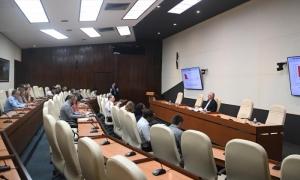
In a high-profile meeting this week between Cuban leadership and top national health scientists, the National Center for Scientific Research (CNIC) has unveiled encouraging clinical trial results for two lines of new natural-product based therapies targeting post-stroke cognitive impairment and common dermatological conditions, advancing the institution’s decades-long legacy of innovative biomedical research.
The presentation was delivered to Miguel Díaz-Canel Bermúdez, First Secretary of the Party’s Central Committee and President of the Republic of Cuba, during the country’s regular consultative exchanges between government leadership and scientific health experts. Per Dr. Sarahí Mendoza Castaño, Director of Research, Development, and Innovation at CNIC, all the developed products have already demonstrated clear efficacy and safety in trials. These developments will not only expand Cuba’s domestic portfolio of accessible medical treatments for its population but also position the country to compete in the global pharmaceutical market.
The most high-profile outcome shared was from a clinical trial investigating the combination of policosanol, the active ingredient in CNIC’s iconic PPG first developed by the center in the late 1980s, paired with a low 81-milligram daily dose of aspirin, for the treatment of post-ischemic-stroke cognitive impairment. The 12-month controlled study enrolled 100 male and female patients with an average age of 69, all living with post-stroke cognitive decline, and split participants into two separate treatment groups for comparative analysis.
Researchers recorded measurable, significant improvement in cognitive function as early as 45 days after the start of treatment across both groups. “With this study, we demonstrate for the first time that long-term therapy with 20 milligrams of policosanol and a daily dose of 81 milligrams of ASA improves both functional recovery and post-stroke cognitive impairment in patients who have suffered an ischemic stroke,” explained Dr. Javier Sánchez López of Cuba’s Center for Neurology and Neurosurgery.
The neurologist noted that the initial results open doors for expanded use of the combination therapy down the line. “This is a promising result, and we are preparing to use this therapy in the future for vascular parkinsonism, because policosanol clearly protects the vascular tree; therefore, in any condition involving this type of damage, its effect will be beneficial. That is our hypothesis, and the results have been encouraging in this initial study.”
Given that ischemic stroke is a major contributing factor to late-life dementia, Sánchez López emphasized the critical public health value of this breakthrough. As global life expectancy continues to rise, cognitive decline has become an increasingly common burden on older populations. “Any product, any trial that points to an improvement is welcomed as a relief, knowing that we want to live longer, but also with a better quality of life, and even more so by using natural products, which are highly reliable and safe for medical use,” he added.
Alongside the stroke therapy research, CNIC also shared new data on dermatological treatments based on ozonized sunflower oil (OSO). Researchers conducted trials testing the efficacy of OSO cream paired with specialized sulfur-based AGO soaps for multiple common skin conditions. One trial focused on acne patients, enrolling 75 participants (average age 24, majority female) split into three groups: one receiving only OSO soap, one only OSO cream, and the third a combined therapy of both products.
All three groups recorded clinical improvement, higher assessment scores, and better quality of life after treatment, with the combined therapy delivering notably stronger results than either monotherapy. CNIC plans to continue testing these dermatological products with larger patient cohorts and longer treatment periods to confirm the initial positive outcomes. A separate eight-week trial of OSO soap paired with an alcohol-based anti-inflammatory OSO cream for chronic dermatitis, which enrolled 90 patients, also returned promising preliminary results, which are currently under peer review. Additional promising early data was also shared for rectal ozone therapy as a treatment for persistent joint pain following the acute phase of chikungunya infection.
President Díaz-Canel praised the new achievements from CNIC, an institution founded in 1965 by former Cuban leader Fidel Castro Ruz that holds the distinction of being the founding core of Cuba’s network of revolutionary scientific institutions, evolving from the original Scientific Pole into today’s Biocubafarma. The center’s latest breakthroughs confirm that six decades after its founding, CNIC remains fully committed to addressing high-priority biomedical and technological challenges that advance Cuba’s economic and social welfare, while developing cutting-edge, globally competitive pharmaceutical products.