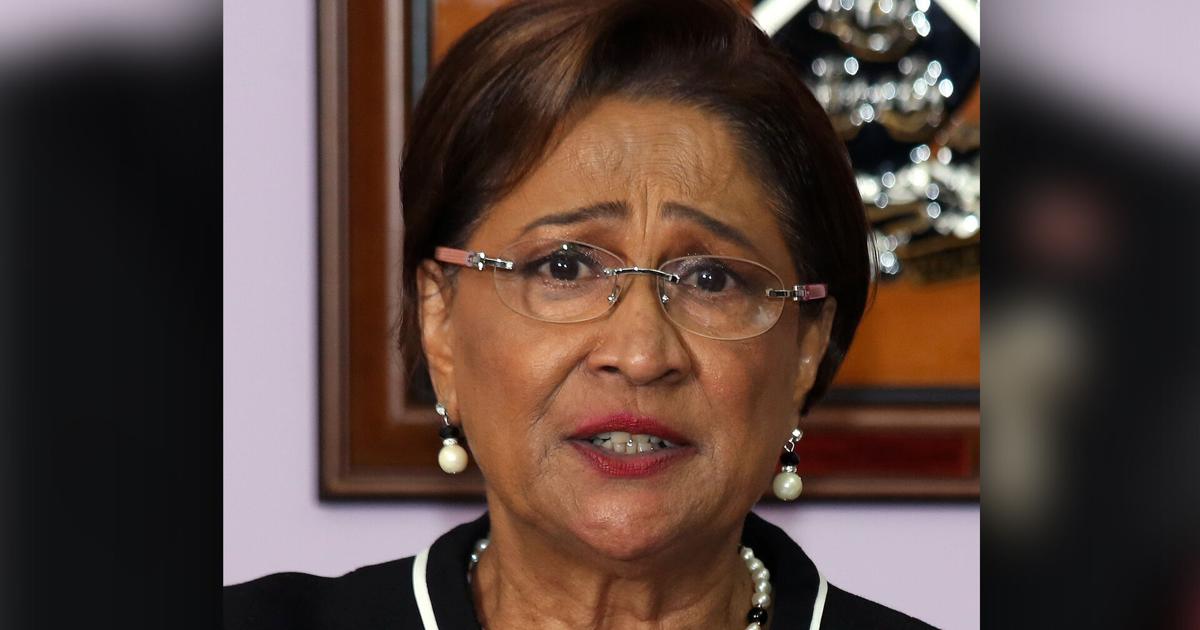
A growing procedural dispute within the Caribbean Community (CARICOM) has taken center stage, as Prime Minister Kamla Persad-Bissessar of Trinidad and Tobago has doubled down on demands for full transparency surrounding the controversial reappointment of Secretary-General Dr. Carla Barnett.
In a public statement shared to Facebook on Monday, Persad-Bissessar condemned the reappointment process as “surreptitious and odious”, and made clear her administration would not back down from challenging the outcome until the matter is addressed with full openness. While Trinidad and Tobago, CARICOM’s single largest budget contributor, remains fully committed to the regional bloc, the prime minister warned that her government would offer “no quarter” to the organization and its secretariat until procedural fairness is restored.
Far from being an ordinary bureaucratic appointment, Persad-Bissessar emphasized the five-year term of the secretary-general carries sweeping long-term consequences for Trinidad and Tobago, touching core national priorities including economic trajectory, domestic security, regional integration efforts, and foreign policy direction. “In the interest of my citizens’ well-being, I will mercilessly, relentlessly, and if needed, ruthlessly publicly prosecute this matter until transparency is achieved,” she said.
The row dates back to the 50th Regular Meeting of the Conference of Heads of Government hosted by St. Kitts and Nevis, where Dr. Barnett’s second term, set to begin in August 2026, was approved. Per the Trinidad and Tobago government’s account, the reappointment was never added to the meeting’s official provisional agenda, never debated or voted on during the public plenary session, and was only addressed during a closed-door heads of government retreat from which Trinidad and Tobago and other member states were barred from sending their authorized representatives.
Trinidad and Tobago argues the process directly violates Article 24 of the Revised Treaty of Chaguaramas, the foundational legal framework of CARICOM, which requires the full Conference of Heads of Government to formally consider and approve all secretary-general appointments. In legal terms, the government maintains the reappointment is ultra vires, or outside the legal bounds of the treaty.
Official objections have been moving forward for months: On March 25, 2026, Foreign and CARICOM Affairs Minister Sean Sobers formally submitted Trinidad and Tobago’s objection in an official letter to CARICOM Chair Dr. Terrance Drew. Two days later, Sobers reaffirmed the position on the floor of Trinidad and Tobago’s parliament. On March 31, the government sent two additional formal requests for clarification: one addressed to Drew and Barnett, asking for full details on when the item was added to meeting materials, what communications were sent to member states, whether post-meeting notifications were issued after the joint closing communiqué, and why the matter was treated as confidential. A separate request was sent by the Foreign Ministry’s permanent secretary to the Chef-de-Cabinet of the Secretary-General’s Office, seeking all relevant documentation related to the process.
As of Persad-Bissessar’s latest statement, no response has been received from CARICOM leadership. The prime minister noted that past reappointments, including the 2016 selection, followed long-established, inclusive procedures that incorporated input from all heads of government, and the current process falls far short of CARICOM’s own written rules of procedure. “The people of Trinidad and Tobago who finance 22% of CARICOM’s budget deserve transparency, accountability, and faithful adherence to agreed rules,” she said.
Addressing parliament last month, Minister Sobers expanded on the government’s position, arguing that the furtive process has already caused “irreparable harm” to the regional bloc, noting that Trinidad and Tobago was completely sidelined from the decision. He commended Persad-Bissessar for openly raising concerns about institutional shortcomings during the February CARICOM heads meeting, saying he hoped other regional and global leaders would show similar courage to address procedural gaps openly.
Sobers stressed that all CARICOM citizens are owed confidence in the institution’s governance, which can only exist if all actions align with the Revised Treaty of Chaguaramas. As the bloc’s largest annual contributor, he added, Trinidad and Tobago is owed the basic respect of inclusive, rule-following process. The government has proposed placing the reappointment dispute on the official agenda for the next CARICOM Heads of Government meeting, scheduled to take place July 5-8 in St. Lucia.
Despite the standoff, Sobers reaffirmed that Trinidad and Tobago remains committed to reforming and revitalizing CARICOM and its secretariat to ensure the institution meets the needs of the entire region. The government recognizes the critical importance of the CARICOM single market to private sector growth across the bloc, he noted, pointing out that Trinidad and Tobago is both the largest importer and largest exporter of goods within CARICOM. At its core, the dispute is a defense of national interests and institutional integrity, not a rejection of regional cooperation: “We are a country that abides by the rules of CARICOM. We conduct our business with transparency and accountability, and we expect the same for all within the community,” Sobers said. He also outlined the scale of Trinidad and Tobago’s annual contributions to core CARICOM institutions, including $35.5 million to the CARICOM Secretariat, $25 million to the CARICOM Development Fund, $1.4 million to the Caribbean Disaster Emergency Management Agency, $16.1 million to CARICOM IMPACS, $10.3 million to the Caribbean Examinations Council, $14 million to the Caribbean Public Health Agency (CARPHA), $23.3 million to the Caribbean Industrial Research Institute, and $1.3 million to the CARICOM Competition Commission.