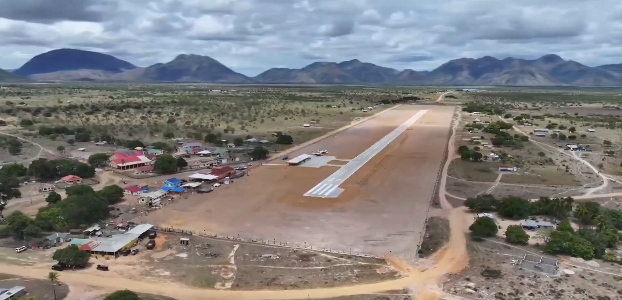
Following the official inauguration of the upgraded Karasabai Airstrip in Guyana’s remote Region Nine on Saturday, President Irfaan Ali has announced a suite of targeted investments designed to turn the Rupununi region into a high-output agricultural hub, addressing long-standing logistical barriers that have stifled local economic growth for decades.
The airstrip, which serves roughly 1,200 local residents, received a total investment of GY$1.53 billion for its expansion and modernization. Beyond enabling improved access to remote communities, the upgraded infrastructure is the cornerstone of the government’s plan to boost large-scale commercial agriculture in the area, which has already shown promising early output. President Ali confirmed that a 20-tonne industrial blast freezing refrigerator will be deployed to the region in the coming months to preserve fresh produce, meat, and other perishable goods before they are transported via air and road to markets in Georgetown and other population centers across Guyana.
“Our goal is to maximize the economic value this new airstrip delivers to local communities,” Ali explained during the commissioning ceremony. “This 20-tonne unit will blast-freeze even locally produced meat, helping us build the cold storage capacity we need to reliably move fresh goods from Rupununi to national markets.”
The government’s agricultural expansion strategy focuses on scaling up production of high-value crops including coffee, peanuts, ginger, and onions, in close partnership with smallholder farmers across Karasabai and surrounding areas. President Ali noted that the administration is actively facilitating private sector partnerships with local small farmers to turn agriculture into the region’s primary economic driver, unlocking sustained value from the upgraded airstrip infrastructure.
Early results from existing commercial production in Rupununi already point to major untapped potential. Local Toka region is renowned for its large, high-quality watermelons: one farm produced 100,000 watermelons for shipment to Georgetown last year alone, with another 4,000 units shipped out just last week. Local tomato production has also hit industrial-scale output, reaching 20 kilogrammes of tomatoes per plant. For onion production, which Guyana first attempted to scale in the interior roughly 50 years ago, transportation bottlenecks have long derailed past efforts. Today, President Ali confirmed that full approval has been granted for large-scale onion cultivation, as long as local villages commit large tracts of land to the project. The government will centralize regional logistics and invest in purpose-built transportation vehicles to move onion harvests from Rupununi to national markets.
“We’re not asking for anything more than for local villages to commit to production,” Ali said. “Follow the example of the successful watermelon farms and scale up output – that’s all we need to make this work.”
Beyond agricultural development, the upgraded airstrip will also deliver critical public benefits to the remote region. President Ali announced that the government has reached an agreement with Jag’s Aviation to launch once-weekly scheduled commercial passenger flights to Karasabai, improving connectivity for residents. The expanded runway is also engineered to accommodate delivery drones, which will be used to transport emergency blood supplies from Lethem to Karasabai, cutting response times for critical medical emergencies.
At the same time, the announcement leaves one key outstanding question unanswered: it remains unclear how large-scale agricultural operations will be protected against the widespread severe flooding that regularly impacts large swathes of the Rupununi region, a recurring natural challenge that could threaten crop stability and long-term output.