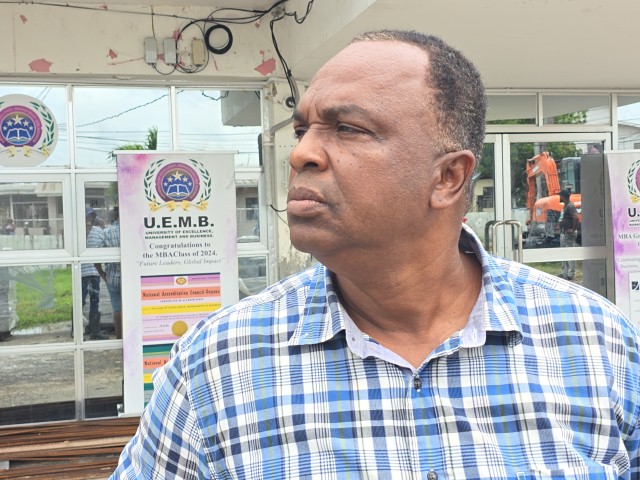
A looming legal battle over property rights has pushed a private Guyanese higher education institution to the brink of permanent closure, with its top leader warning that an unfavorable court ruling would immediately end all operations. As of Monday, April 6, 2026, Stanley Paul, President of the University of Excellence, Management and Business Inc. (UEMBI), confirmed the private university is set to wind down operations by December 2026 if the High Court rules against it in the ongoing possession dispute over the Critchlow Labour College (CLC) building in Georgetown.
The core of the legal conflict centers on the validity of a 15-year commercial lease agreement UEMBI signed with former CLC principal Ivor English in June 2025. The lease, which grants UEMBI access to the Woolford Avenue property originally leased to CLC by the Mayor and City Council of Georgetown in 1968, was struck at a time when Critchlow Labour College Inc. (CLCI), the legal entity behind the college, had been struck off Guyana’s Companies Register. CLCI was removed from the register in November 2013 and only restored in November 2025, months after the lease was signed. CLCI argues that English never held authorization as a director or officer of the institution to sign the lease, making the entire agreement a legal nullity.
In its court filings, CLCI is seeking multiple court orders: an injunction barring UEMBI from any construction activity on the property, a formal ruling that UEMBI’s continued occupancy constitutes trespassing, and compensatory damages totaling GY$3,106,000 per month dating back to September 2025 for unlawful possession. CLCI also adds that UEMBI’s ongoing construction work violates Georgetown’s municipal building bylaws, as no legally approved construction plan was ever secured. Paul, however, has staunchly defended the lease’s validity, noting he had no prior notice of CLCI’s struck-off status or English’s alleged lack of authority, and that English openly represented himself as an authorized agent for the institution during negotiations. Per the terms of the agreement, Paul says UEMBI paid GY$4 million in advance rent, with monthly rent set at GY$1 million starting September 1, 2025, and the agreement includes an automatic renewal clause after the initial 15-year term.
Complicating UEMBI’s position ahead of the scheduled April 7, 2026 hearing, the institution has now lost its fourth consecutive legal representative, after attorney Joelle Harmon-Alstrom withdrew her representation effective April 1, 2026. Paul told reporters the split stemmed from disagreements over case strategy: Paul pushed to highlight new, critical points raised in CLCI’s latest court submissions, while Harmon-Alstrom opted not to proceed with that framing. To date, Paul says UEMBI has spent GY$2.5 million on legal representation across four different lawyers, and he remains dissatisfied with all of the work the firm has provided.
Paul confirmed that following Harmon-Alstrom’s withdrawal, he notified enrolled students of the planned December 2026 closure, but added that the shutdown is contingent on two key outcomes. First, the closure will only move forward if the High Court rules to eject UEMBI from the property. UEMBI’s accreditation is explicitly tied to its current location, meaning the university cannot relocate or continue operations elsewhere if it loses the building. Second, Paul says the university remains open to a transfer arrangement if a qualified, credible buyer steps forward before the end of 2026 to take over operations, a provision included to protect student interests and maintain continuity of education. The National Accreditation Council of Guyana has responded to Paul’s closure notice, calling for him to issue a more clear, definitive plan rather than attaching caveats to the proposed shutdown.
Ahead of Tuesday’s hearing, Paul says he intends to request additional time from Justice Fidela Corbin-Lincoln to secure new legal representation, as well as permission to file a newly drafted reply affidavit. The final outcome of the ruling will determine the future of the private university and its student body, with one of Guyana’s newer private higher education institutions facing complete dissolution over the disputed property agreement.