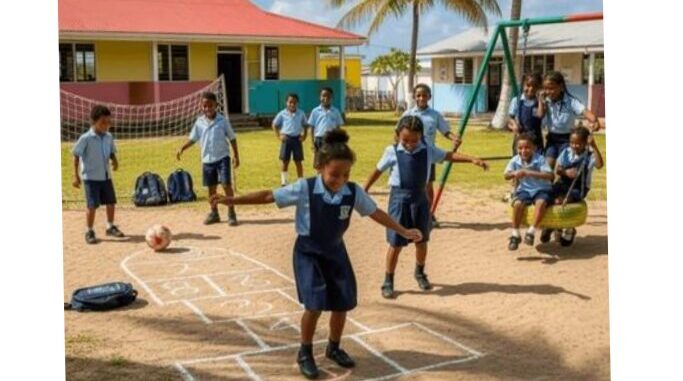
As the international community marked World Day of Physical Activity on April 6 and World Health Day on April 7 2026, two Caribbean public health advocates are calling for a return to the region’s deep-rooted cultural tradition of spontaneous, community-centered play as a foundational solution to growing public health crises.
For generations across Caribbean island nations, unstructured physical movement was woven into the very fabric of childhood. Simple, shouted calls—“RUN!”, “HOME!”, “OUT!”—sent generations of children sprinting across sunbaked fields, dodging opponents and chasing victory across open community spaces. Long before “physical activity” became a formal public health term, movement was just part of how children lived: through local games adapted to every island’s unique culture and landscape.
In Barbados, children repurposed city sidewalks into makeshift courts for road tennis, gripping rough wooden paddles to rally back and forth across chalked boundary lines. In Trinidad and Tobago, traditional games like Scotch, Moral and Peesay had children hopping, balancing, and jumping in steady rhythm, while marble matches kept competitors crouched for hours, honing focus and fine motor control. Jamaica’s beloved Dandy Shandy and Stuck and Pull had children running, twisting, and laughing together, filling neighborhood open spaces with squeals of delight. From rounders to chase, every island had its own set of rules, its own shared calls, and its own memories of movement tied to community connection. This spontaneous play was never structured or formal—but it acted as an informal, remarkably effective public health system, building physical strength, coordination, emotional resilience, and tight social bonds across generations.
Today, however, that legacy of natural daily movement has faded. The rise of screen time, packed structured schedules, and the loss of open community play spaces have pushed traditional childhood games out of schoolyards and neighborhoods. What was once an automatic part of growing up has been replaced by a modern narrative that frames physical activity as something that only happens in gyms, structured fitness programs, or competitive performance contexts—erasing the Caribbean’s own cultural foundation of free movement in the process.
This shift is not just a loss of cultural nostalgia; it has created a measurable public health crisis across the region. Non-communicable diseases (NCDs) including hypertension, type 2 diabetes, and heart disease now account for more than 70% of all deaths across the Caribbean, and the region holds one of the world’s highest rates of premature death from NCDs among people aged 30 to 70. Public health researchers point to physical inactivity, alongside unhealthy diets, tobacco use, and excessive alcohol consumption, as a key driver of this crisis. Currently, 30 to 40% of all Caribbean adults fail to meet the World Health Organization’s recommended minimum weekly physical activity levels, a trend that traces back to the decline of active play in childhood. The “stillness” that has replaced neighborhood games in childhood follows people into adulthood, creating lifelong health risks that strain regional healthcare systems, which must bear the cost of long-term treatment, medications, and ongoing care for preventable chronic conditions.
As the authors, youth public health advocate Kayla Wright and sports medicine and physiotherapy specialist Offniel Lamont, both advocates with the Healthy Caribbean Youth and Healthy Caribbean Coalition, note, the traditional Caribbean saying “prevention betta dan cure” holds true here—but most current prevention efforts focus only on changing adult behavior, rather than restoring the community and school environments that made daily movement natural for children. Reclaiming this tradition of active play is not just about nostalgia; it is about recognizing that good health is built early in life, through shared, joyful community activity.
Regional policymakers have already laid the groundwork for action. CARICOM member states have enshrined the right to health in national policy frameworks, and the Caribbean Public Health Agency (CARPHA) has developed the Six-Point Policy Package, a targeted strategy to combat NCDs and childhood obesity across the region by transforming food and activity environments. Regional initiatives like Caribbean Moves have launched national public campaigns to promote active lifestyles, spurring local programs including Jamaica Moves, Dominica’s Fit for Life Campaign, St. Lucia’s National Physical Activity Day, and Barbados’ Creative Play Initiative. Recent policy moves, such as Jamaica’s proposed sugar-sweetened beverage tax, also signal growing recognition that systemic action to address the root causes of NCDs is critical. The path forward, the authors argue, does not require new policy promises—it requires full implementation of the commitments regional leaders have already made, starting with recognizing safe, accessible, unstructured play as a core public health priority that cannot be overlooked.
On this year’s back-to-back global health observances, the message from the region’s advocates is clear: daily movement is not a privileged lifestyle choice for the wealthy—it is a birthright, and a core part of Caribbean cultural heritage that must be protected. If the region is serious about preventing chronic illness and improving long-term public health, policymakers, schools, and communities must make space once again for the joyful, traditional play that defined generations of Caribbean childhood.