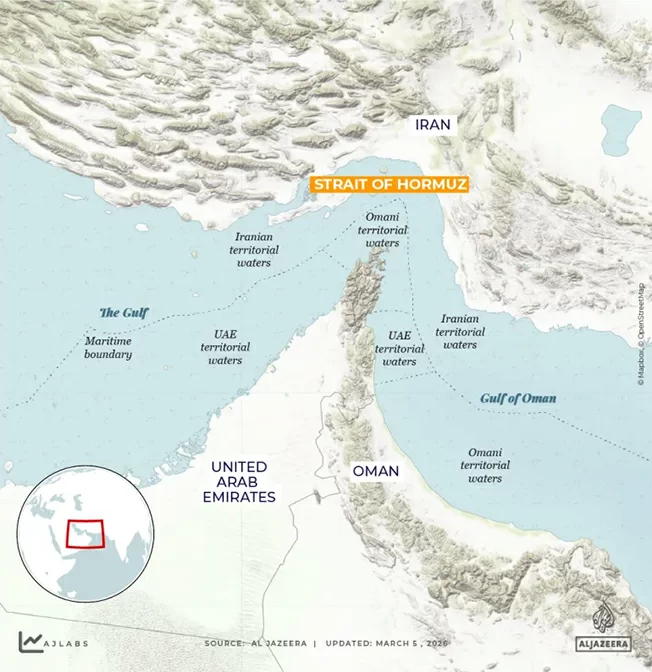
Since late February, one of the world’s most critical energy chokepoints, the Strait of Hormuz, has been effectively closed by Iranian authorities, sending shockwaves through global energy markets and creating a stark divide in financial outcomes for oil-producing nations across the Middle East, a new Reuters analysis finds. Roughly 20% of the world’s daily oil and liquefied natural gas flows pass through this narrow waterway, making its disruption a major global economic flashpoint.
The closure followed escalating regional tensions after the United States and Israel launched airstrikes on Iranian targets. While Iran later relaxed restrictions to allow vessels with no American or Israeli links to transit, keeping a small number of tankers moving through the strait, global energy markets have remained extremely volatile. Brent crude prices recorded a historic 60% jump in March alone, a surge that has reshaped revenue calculations for every major producer in the region.
The uneven impact of the crisis boils down to one key factor: geography. Nations that control the strait or have pre-built alternative export routes are reaping massive financial windfalls from sky-high prices, while countries dependent entirely on Hormuz access are facing catastrophic revenue losses.
Iran, which controls access to the strait, has seen its oil revenue climb 37% compared to last year. Oman and Saudi Arabia have also posted gains: Omani revenue rose 26% year-on-year in March, while Saudi Arabia recorded a 4.3% increase. The United Arab Emirates (UAE) saw a modest 2.6% dip in revenue, as higher global prices offset most of the losses from reduced export volumes.
Saudi Arabia’s ability to weather the crisis stems from a key infrastructure investment made decades ago. During the 1980s Iran-Iraq War, the kingdom built the 1,200-kilometer East-West Pipeline, which connects its eastern oilfields directly to the Red Sea port of Yanbu, bypassing the Strait of Hormuz entirely. Since the closure, the pipeline has been operating at full capacity of 7 million barrels per day. Even though Saudi Arabia’s total crude export volume dropped 26% in March, the record-high oil prices pushed the total value of its exports up by more than $550 million compared to typical monthly levels. Exports through Yanbu have operated near maximum capacity despite recent attacks on the port, though the kingdom remains vulnerable to further strikes on its energy infrastructure and the nearby Bab el-Mandeb shipping lane from Iran and its Houthi allies in Yemen.
For nations without alternative export routes, the picture is far grimmer. Iraq and Kuwait have been hit hardest, with year-on-year revenue drops of 76% and 73% respectively in March. Iraq’s total oil revenue for the month fell to just $1.73 billion, while Kuwait’s dropped to $864 million. Iraq saw limited support from cargoes that departed just before the escalation of tensions, but analysts warn April revenue will likely be even lower. Qatar has also suffered steep losses due to its lack of alternative export infrastructure for both oil and gas.
The UAE, which operates the Habshan-Fujairah pipeline that can bypass Hormuz with capacity between 1.5 million and 1.8 million barrels per day, still saw its total revenue fall by more than $174 million in March after attacks targeted the Fujairah port, disrupting operations.
Looking ahead, most Gulf states appear to have the financial buffer to absorb this short-term shock, according to Adriana Alvarado, vice president at ratings firm Morningstar DBRS. With the exception of Bahrain, most regional governments hold enough reserve savings and maintain public debt levels below 45% of GDP, giving them room to borrow or draw down savings to offset temporary revenue losses.
In the longer term, the crisis has reignited global debates over energy security. Some Western oil companies and political leaders are calling for increased investment in fossil fuel production to avoid future supply disruptions, but many energy analysts argue that accelerating the transition to renewable energy is the only durable protection against future geopolitical price shocks. A recent high-profile example of this transition push came earlier this year, when French energy giant TotalEnergies and UAE-backed renewable firm Masdar announced a $2.2 billion joint venture to rapidly scale up renewable energy development across nine Asian nations.
As the standoff over the strait continues, with U.S. President Donald Trump threatening severe retaliation against Iran if the waterway is not reopened by Tuesday, the global energy industry remains on edge, waiting to see how the crisis will reshape long-term energy policy and market dynamics.