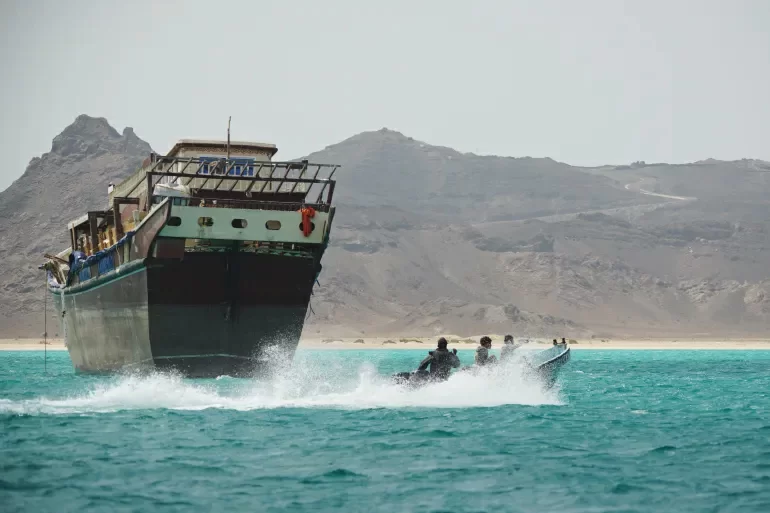
As escalating tensions between the United States and Iran continue to roil the Middle East, senior Iranian officials have issued stark new threats that Iranian-aligned forces could shut down the strategically vital Bab al-Mandeb strait, a move that would upend global energy supplies and international commerce. The warning comes after Iran effectively restricted shipping through the Strait of Hormuz, another critical chokepoint for global energy trade, and follows escalating hostile rhetoric between Tehran and the Trump administration.
Top advisers to Iran’s Supreme Leader and veteran Iranian diplomats have doubled down on the threat of closing the strait. Mojtaba Khamenei, a senior adviser to Iranian Supreme Leader Ali Khamenei, warned that Iran’s regional allies could shut down Bab al-Mandeb in the same way Iran has already constrained access to the Strait of Hormuz. Ali Akbar Velayati, an influential former Iranian foreign minister, reinforced the message, stating that the unified command structure of the so-called ‘Axis of Resistance’ views Bab al-Mandeb as strategically equivalent to Hormuz. If the White House continues what Velayati called its ‘foolish mistakes,’ he warned, global energy and trade flows could be disrupted with a single action. Iran’s state-owned broadcaster Press TV has officially confirmed these warnings.
The threats are a direct response to recent aggressive rhetoric from former U.S. President Donald Trump, who has threatened to bomb Iranian energy infrastructure, including power plants, bridges, and desalination facilities, if the Strait of Hormuz remains closed to international traffic. Iran has countered that the strait remains open to shipping from most nations that negotiate safe passage, explicitly excluding only the United States and Israel.
### Why Bab al-Mandeb Matters to the Global Economy
Located between Yemen on its northeastern shore and Djibouti and Eritrea in the Horn of Africa to the southwest, Bab al-Mandeb links the Red Sea to the Gulf of Aden, which connects to the Indian Ocean. At its narrowest point, the strait is just 29 kilometers wide, with only two shipping lanes for incoming and outgoing traffic, making it extremely vulnerable to blockades. Today, the strait is effectively controlled by the Iran-backed Houthi movement of Yemen, which is part of Tehran’s ‘Axis of Resistance,’ a coalition of ideologically and tactically aligned groups across the Middle East.
As the only maritime gateway from the Indian Ocean to the Red Sea, which connects via the Suez Canal to the Mediterranean, Bab al-Mandeb handles roughly 12 percent of total global trade every year. A closure would force commercial vessels to divert on to a much longer route around the southern tip of Africa, extending delivery times by 10 to 14 days and sharply increasing shipping and insurance costs.
In 2024 alone, roughly 4.1 billion barrels of crude oil and refined petroleum products passed through the strait, accounting for 5 percent of total global seaborne oil shipments. When combined with the Strait of Hormuz, which normally carries 20 percent of the world’s oil and natural gas, a simultaneous closure of both chokepoints would block 25 percent of global energy supplies. Beyond energy, roughly 10 percent of all global container trade, including goods shipped from China, India, and other Asian manufacturing hubs bound for European markets, transits the strait.
The strategic importance of Bab al-Mandeb has grown dramatically since Iran restricted access to the Strait of Hormuz. Saudi Arabia, which historically relied heavily on Hormuz for its oil exports, has increasingly shifted shipments through its Red Sea port of Yanbu, using the East-West Pipeline that runs from the Abqaiq oil field to Yanbu, operated by state oil giant Aramco. In March, the pipeline was operating at full capacity of 7 million barrels per day, an all-time record, reflecting the new reliance on the Bab al-Mandeb route.
### Can the Houthis Actually Close the Strait?
Yemen’s Houthi movement has already demonstrated its ability to disrupt shipping through the strait. During the 2023-2024 Gaza war, the group launched repeated attacks on vessels it deemed linked to Israel or the United States, prompting global insurance providers to stop covering commercial ships transiting the area. Shipping volumes through the strait fell sharply as a result, before a ceasefire agreement between the U.S. and the Houthis in May 2025 reopened the route to most traffic.
In recent weeks, the Houthis have resumed rocket and drone attacks targeting Israel, marking their renewed participation in regional hostilities, though they have not yet resumed attacks on U.S.-linked commercial shipping. Former U.S. diplomat Nabeel Khoury noted that recent Houthi attacks are largely symbolic, intended as a warning against escalating regional tensions and the deployment of additional U.S. forces to the Middle East. But if the group decides to fully escalate, closing Bab al-Mandeb is its most powerful weapon.
“All they need to do is attack a handful of ships passing through, and all commercial shipping in the Red Sea will come to a standstill,” Khoury explained. “That would cross a red line, and you would very quickly see U.S. and Israeli military strikes on Houthi targets in Yemen.”
### Global Implications of a Closure
Middle East expert Elisabeth Kendall, president of Girton College at the University of Cambridge, described a full closure of Bab al-Mandeb as a “nightmare scenario” for the global economy. If the Strait of Hormuz remains restricted and Bab al-Mandeb is closed, she warned, trade bound for Europe would be severely disrupted, potentially even paralyzed.
“This is an extremely critical situation, and everything depends on what happens next,” Kendall said. She added, however, that the Houthis are likely hesitant to take such a drastic step, as it would provoke a direct military response from Saudi Arabia and trigger broader counterattacks from Western and allied forces. A full closure would also worsen the ongoing global energy crisis sparked by the Middle East conflict, amplifying economic hardship for households, manufacturers, and consumers around the world.