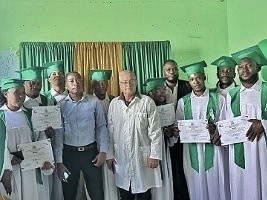
A landmark advancement in Haitian public health infrastructure has been completed in the Nippes department, where local health authorities now boast both a fully trained team of medical entomology specialists and a purpose-built, functional medical entomology laboratory. The milestone comes as a direct outcome of longstanding bilateral health cooperation between Haiti and Cuba, with medical experts from the Cuban Medical Brigade in Haiti leading hands-on training for a cohort of emerging local healthcare professionals.
Over the course of several months, roughly 10 participating healthcare workers completed a rigorous program of technical and scientific instruction. The training equipped participants with core competencies across every key domain of medical entomology, from accurate species identification and laboratory analysis to the development and execution of targeted vector control strategies.
This capacity-building initiative aligns with the core public health vision laid out by Haiti’s Minister of Public Health, Dr. Sinal Bertrand, who has prioritized expanding access to high-quality, locally accessible healthcare services for all Haitian communities. The project was executed under the direct leadership of Dr. Esther Ceus Dumont, Departmental Health Director of Nippes, whose ongoing work has centered on strengthening the resilience and operational capacity of the department’s local health system.
Public health experts emphasize that the new local capacity addresses a long-unmet critical need in Nippes. Prior to this initiative, the department lacked on-site specialized personnel to proactively manage the threat of vector-borne diseases, which remain a persistent public health risk across much of Haiti. Today, the trained team based at Sainte-Thérèse Hospital is fully prepared to detect, respond to, and contain outbreaks of high-burden vector-borne illnesses including dengue fever, malaria, and chikungunya.
Beyond the certified professional workforce, the project’s most transformative tangible achievement is the newly established entomology laboratory housed within Sainte-Thérèse Hospital. The modern facility is purpose-built to support routine entomological analysis, ongoing regional disease surveillance, continuing professional education for local health staff, and rapid deployment of field intervention teams when vector-borne disease cases are detected.
With trained staff in place, lab infrastructure fully operational, and a dedicated new public health service ready to serve community members directly, Nippes has crossed a major threshold in its efforts to build a robust, responsive local health system. The project sets a model for bilateral cooperation to address unmet public health needs across other regions of Haiti.