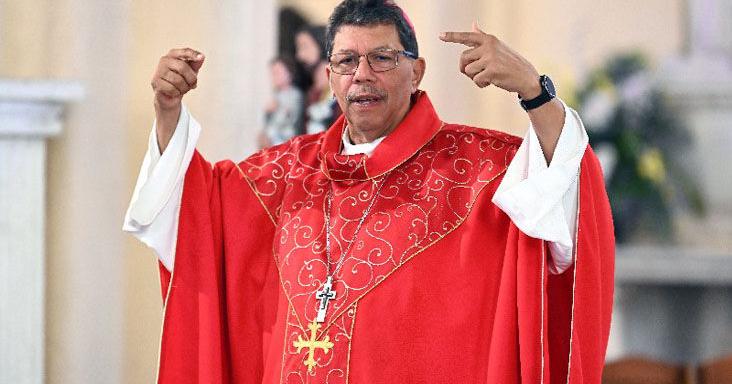
On Good Friday, at the Cathedral of the Immaculate Conception in Port of Spain, Roman Catholic Archbishop Fr Jason Gordon delivered a stirring homily during the annual ‘Good Friday: The Passion of the Lord’ service, challenging congregants to examine their relationship with Jesus Christ and live out their faith through bold, ethical action.
The service carried all the traditional hallmarks of Good Friday observance: many worshippers arrived wearing red, a color chosen to symbolize the blood Christ shed during his crucifixion, while all crosses in the cathedral were draped in red cloth. As one cross was slowly unveiled to the gentle, melodic strains of local steelpan music, attendees knelt forward one by one to kiss the wooden symbol in a moment of quiet devotion. The gathering also included intercessory prayers for the nation, its civic and political leaders, and the senior leadership of the regional church.
Gordon opened his reflection by centering the well-known biblical story of Peter’s three denials of Jesus in the Garden of Gethsemane, arguing that the story is not just an ancient historical account but a mirror for modern believers. Confessing his personal affection for the disciple Peter, Gordon told the congregation: ‘We are Peter. We allow Christ to be crucified again today.’ He pressed attendees to set aside personal pride and ask whether they are willing to stand for their faith even when doing so is socially inconvenient, asking: ‘Every time we are called to the cross, do we say “I am here?”‘
Gordon expanded this argument to address pressing modern social ills, pointing specifically to the ongoing crisis of domestic violence. He stressed that when communities stay silent about abuse that harms children, breaks apart families, and scars generations, they perpetuate the same rejection of Christ that Peter demonstrated two millennia ago. This silence extends beyond the home, he added: when employees witness unethical actions unfolding in workplaces and choose to stay silent out of self-interest, or when leaders with global power make harmful, self-serving decisions that harm vulnerable populations, they too reject Christ and perpetuate his crucifixion in the modern day.
Drawing a parallel to the shared global experience of the COVID-19 pandemic, Gordon reminded attendees that the public health crisis stripped all people bare, stripping away many of the distractions and social constructs that people rely on to avoid self-examination. During the worst of the pandemic, large public gatherings like this Good Friday service were banned, with even small groups of five people restricted from gathering, a situation Gordon said echoed the fear and isolation Christ faced in the hours before his crucifixion. Just as the world was laid bare during that crisis, Gordon urged congregants to ‘strip themselves bare’ of their own pretensions, much like the stripped Good Friday altar, to draw closer to God. This call included an invitation to deep personal introspection, rooted in the core Christian belief that Christ bore the sins of all humanity during his crucifixion.
Beyond calling out silence and inaction, Gordon issued a clear call to action: he urged believers to speak up openly about domestic violence when they see it, and to embrace the call to be ‘their brothers’ keepers’ in both domestic spaces and workplaces. He closed his homily by reminding the congregation to remain rooted in focus on Christ, through fervent prayer and authentic worship, both in times of crisis and in periods of peace and stability.