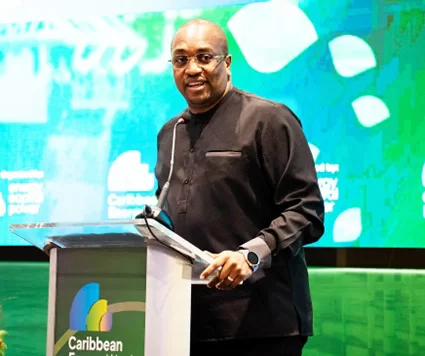
Opening the 2026 Caribbean Energy Week on Tuesday in Paramaribo’s iconic Royal Torarica venue, Suriname’s Minister of Foreign Affairs, International Business and International Cooperation Melvin Bouva laid out the South American nation’s ambitious strategy: leverage its rapidly expanding oil and gas industry as a springboard for sweeping national economic transformation and deeper global partnership.
The three-day industry conference brings together heads of government, institutional investors, and C-suite energy executives from across the globe, with a shared goal of cementing the Caribbean region’s status as one of the world’s fastest-growing emerging energy hubs. In his opening keynote address, Bouva framed Suriname’s current moment as a historic turning point. Recent large-scale offshore oil and gas discoveries have already catapulted the small nation onto the global energy map, drawing unprecedented attention from international energy firms and capital markets.
But Bouva issued a clear caution: rich natural resource endowments alone do not guarantee long-term shared prosperity. Instead, he argued, the oil and gas sector must act as a catalyst to drive diversification across Suriname’s broader economy, rather than serving as an end goal in itself. His vision positions the emerging energy industry as the foundational base to nurture local entrepreneurship, upskill national workforces, and incubate entirely new domestic industries across other sectors.
“The success of our energy sector will not be measured solely in barrels of oil produced or cubic feet of gas extracted,” Bouva emphasized. “Its true success will be counted in the new local businesses it spawns, the marketable skills it builds for our people, and the lasting, mutually beneficial partnerships it forges with the global community.”
International partnerships stand as a core pillar of Suriname’s new economic strategy, according to the minister. In today’s interconnected global economy, he noted, modern diplomacy is no longer limited to political engagement; it is increasingly focused on advancing economic cooperation that delivers mutual benefits. That means connecting untapped regional opportunities to global investment capital, pairing innovative development ideas with financial resources, and aligning Suriname’s national development ambitions with the expertise and scale of international partners.
A key priority of this approach is ensuring natural resource development delivers sustainable, long-term value creation that benefits all Surinamese people, Bouva said. The government is committed to creating space for robust local participation in the energy sector, supporting the growth of domestic Surinamese businesses to compete and thrive alongside large international investors.
To back this strategy, Bouva outlined a series of targeted policy reforms the Surinamese government has already implemented to strengthen the country’s investment climate. These reforms include the enactment of a modern, investor-friendly national investment law, enhanced regulatory capacity for the Suriname Investment and Trade Agency (SITA), and the development of a balanced local content policy designed to maximize the economic spillover benefits of energy development for domestic stakeholders. Through these changes, Bouva said, Suriname is working to establish itself as a transparent, reliable, and open partner for global trade and investment.
In closing, Bouva reiterated that while energy development can serve as a powerful engine for Suriname’s economy, sustained and shared progress ultimately depends on investment in people, collaborative governance, and a clear long-term vision. He called on all attendees and stakeholders to seize the current momentum of the region’s energy boom, and work collectively to build a sustainable, inclusive future for Suriname and the entire Caribbean.