Suriname’s National Assembly has established a parliamentary investigation committee to examine impeachment requests against three former ministers, initiating a process with profound legal and political implications. This preliminary phase has already evolved into a critical test for both parliamentary credibility and the nation’s rule of law.
The committee’s formation revealed underlying coalition tensions when ABOP faction leader and Assembly Vice President Ronnie Brunswijk insisted on chairmanship, declaring he could not function under NDP’s Ebu Jones. Ultimately, NDP faction leader Rabin Parmessar was appointed chair instead.
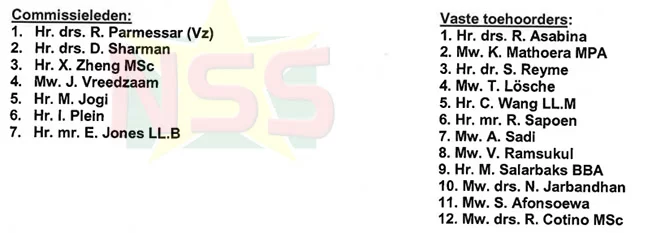
Comprising seven assembly members with twelve permanent observers, the committee convenes Monday to examine the Prosecutor General’s case against former ministers Bronto Somohardjo, Riad Nurmohamed, and Gillmore Hoefdraad. While formally an exploratory phase without substantive judgments, the committee will conduct hearings and analyze documents.
In reality, the stakes are considerably higher: this committee must demonstrate that political interests won’t override a process touching the core of judicial integrity. Additional members include Dew Sharman (VHP), Xiabao Zheng (PL), Jennifer Vreedzaam (NDP), Mahinder Jogi (VHP), Ivanildo Plein (NPD), and Ebu Jones (NDP).
The chairmanship debate highlights the sensitivity of these proceedings. Brunswijk’s exclusion from leadership was institutionally appropriate given his previous vice presidency alongside Somohardjo and Nurmohamed in the former coalition, which would have created apparent conflicts of interest.
However, ABOP’s complete absence from the committee—providing neither members nor permanent observers—complicates matters politically and institutionally. While the party could contribute during public deliberations, its absence from preparatory work undermines broader decision-making legitimacy.
Coalition unity remains elusive regarding the Prosecutor General’s request:
– Pertjajah Luhur: Faction leader Somohardjo publicly supports prosecution, including in his own case
– NPS: Advocates allowing the Prosecutor General to proceed with investigations
– ABOP: Maintains ambiguous positioning
– NDP, A20, and BEP: Have not established formal stances
This lack of consensus increases the likelihood that political considerations may outweigh legal arguments.
The opposition VHP party has notably positioned itself in favor of granting the prosecution request, despite Nurmohamed being a prominent party member.
At the heart of the tension lies Article 140 of Suriname’s Constitution, which establishes a special procedure for political officials unlike ordinary citizens subject to direct criminal prosecution. This provision requires parliamentary approval before prosecution can proceed, effectively making politics the gatekeeper of judicial process.
This constitutional framework creates three fundamental implications:
– Inequality before the law for political officials
– Political considerations influencing criminal prosecution
– Judicial process dependency on parliamentary decision-making
Growing criticism suggests Article 140 may require amendment or abolition as it conflicts with fundamental principles of legal equality.
Current developments reveal systemic vulnerabilities. The chairmanship debate, coalition partner absence, and internal divisions reinforce perceptions that political interests could influence proceedings, shifting focus from substance to process integrity. The coming weeks will prove decisive not only for three former ministers but for Suriname’s entire judicial system.
Should the process:
– Proceed meticulously and convincingly → it will strengthen public trust
– Descend into political conflict → it will damage judicial integrity
The investigation committee has transcended technical exercise to become both a political test for parliament and a mirror reflecting the functionality of Suriname’s rule of law. Beyond three former ministers, this process will inevitably reveal how power, decision-making, and conflict of interest have operated in practice—questioning not only individual accountability but broader political structures.
One certainty emerges: this process will have consequences. As facts sharpen, multiple heads will inevitably roll—political, administrative, or otherwise. The central question becomes not only who faces prosecution, but who remains standing when the full picture emerges.