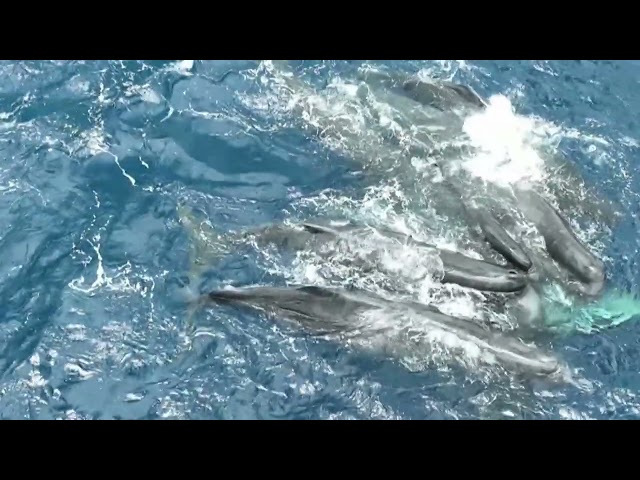
In an extraordinary scientific breakthrough, researchers have captured the first-ever documented evidence of non-primate animals providing active birth assistance. The unprecedented event occurred on July 8, 2023, when an international team from Project CETI witnessed a 19-year-old sperm whale named Rounder giving birth off the coast of Dominica in the Caribbean.
During the five-and-a-half-hour observation period, scientists recorded remarkable cooperative behavior among the 11-whale pod. As Rounder labored to deliver her second calf, multiple female whales—including both relatives and unrelated pod members—positioned themselves beneath her dorsal fin, often swimming on their backs with their heads oriented toward her genital slit. This coordinated assistance represents a previously undocumented phenomenon in marine mammal behavior.
The birth itself lasted approximately 34 minutes, after which the entire pod’s behavior transformed dramatically. Adult whales collectively engaged in supporting the newborn, squeezing the calf between their bodies and using their heads to guide it to the surface. This critical assistance prevented the newborn from sinking and facilitated its first breaths—an essential intervention since newborn sperm whales, though born tail-first as an evolutionary adaptation to aquatic life, initially lack buoyancy.
The research team, whose findings were published in both Scientific Reports and Science journals, noted significant vocalization changes during key moments of the process. These acoustic variations suggest sophisticated communication coordinating the birth support and subsequent protection of the newborn when pilot whales approached the pod.
This observation is particularly significant given that among 93 cetacean species, only nine have been observed giving birth in wild conditions. The survival of the newborn was confirmed when the pod was spotted again in July 2024, with the calf swimming alongside other young pod members—a promising indicator for its progression to adulthood.