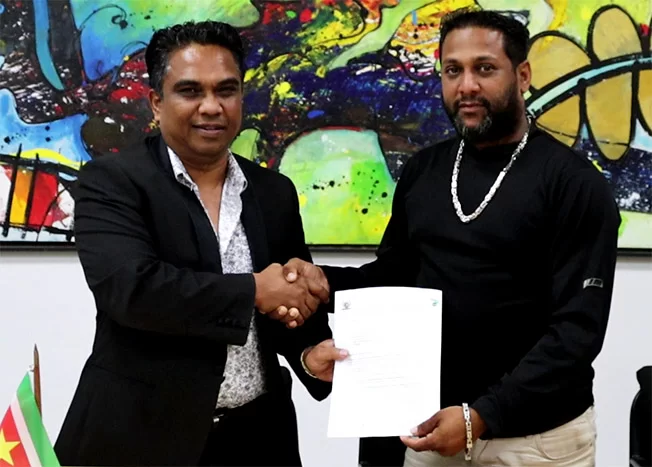
The Surinamese agricultural sector has witnessed a significant development as Minister Mike Noersalim of Agriculture, Livestock, and Fisheries (LVV) and Hansraj Jagmohansingh, Chairman of the Nickerie Paddy Growers Association (VBPN), formalized an expanded support agreement for rice farmers. This agreement substantially increases fertilizer subsidies to address ongoing challenges in the rice industry.
Under the new terms, rice farmers will now receive four bags of fertilizer per hectare distributed across three growing seasons, marking a substantial enhancement from previous arrangements. The decision comes as a response to financial pressures facing farmers who have received lower paddy prices than initially anticipated. While some processors have purchased paddy at prices ranging from SRD 500 to SRD 550 per unit, these rates have proven insufficient to cover production costs.
Minister Noersalim emphasized the government’s commitment to supporting struggling farmers, stating, ‘Farmers are facing severe difficulties and financing challenges. The offered purchase price simply doesn’t allow them to cover their expenses completely.’ This recognition prompted renewed negotiations between stakeholders.
The fertilizer agreement now forms an annex to the existing comprehensive 25-point action plan between LVV and VBPN, which addresses short, medium, and long-term solutions for sustainable development in the rice sector. Both parties expressed satisfaction with the outcome, with Minister Noersalim noting that ‘the farmers’ organization is content and I believe they are returning home satisfied.’
VBPN Chairman Jagmohansingh confirmed this sentiment, stating, ‘I must say I am pleased and returning to my district with a positive outlook.’ He appreciated not only the material support but also the constructive dialogue with government officials, acknowledging that ‘the minister has a listening ear, I see the president has a listening ear.’
Additional measures include a six-month interest freeze on loans for rice farmers, a move that William Waidoe, LVV’s Deputy Director for the Western Region, described as crucial for structural improvement in the sector. Waidoe clarified that despite the government’s limited influence on paddy pricing following market liberalization, LVV remains committed to supporting farmers through strategic interventions where possible, declaring the negotiations ‘a success nonetheless.’