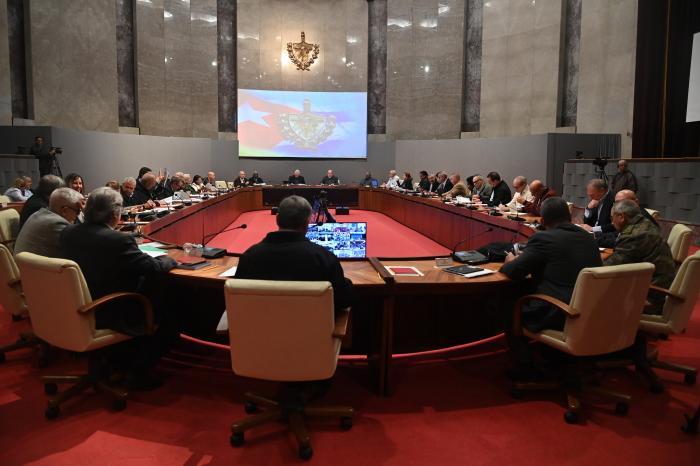
In a significant address to Cuba’s Council of Ministers, President Miguel Díaz-Canel Bermúdez has issued a compelling call for immediate implementation of transformative economic and social reforms. The Cuban leader emphasized that these changes represent the most urgent modifications needed for the country’s economic model, focusing particularly on enhancing municipal autonomy and business independence.
The comprehensive reform agenda encompasses multiple critical areas: business autonomy, municipal self-governance, restructuring of state apparatus, national food production with municipal balance sheets, energy matrix transformation including renewable sources and domestic crude oil utilization, export expansion through foreign direct investment flexibilities, economic partnerships between state and private sectors (especially at municipal level), and business engagement with Cubans residing abroad.
President Díaz-Canel stressed that these measures must collectively contribute to macroeconomic stabilization, increased foreign exchange earnings, and development of national production—with particular emphasis on food security. He noted that success largely depends on the performance of both the business system and municipal governments, urging them to fully utilize granted powers that many have yet to implement or even understand.
The municipal level emerges as the central focus of these reforms, with local governments expected to manage foreign direct investment, operate closed-loop foreign currency systems, facilitate state-private sector partnerships, design local production systems, and handle investments from overseas Cubans.
During the same session, Prime Minister Manuel Marrero Cruz presented the updated “Government’s Economic and Social Program for 2026″—previously known as the Government Program to Correct Distortions and Revitalize the Economy. The revised program maintains ten general objectives while modifying specific targets and increasing measurable indicators. The document, which underwent public consultation and expert review, is scheduled for publication this March and will be updated annually.
Economic Minister Joaquín Alonso Vázquez reported concerning economic indicators from January, with goods exports generally underperforming targets despite strong showings in honey, tobacco, lobster, rum, and biopharmaceuticals. Service exports in healthcare nearly reached 100% of targets, tourism achieved 85%, and telecommunications exceeded expectations. The minister acknowledged progress in 86 foreign currency self-financing schemes across various sectors while noting persistent challenges from the U.S. embargo.
Agricultural production continues to struggle despite intensive efforts, failing to meet population demands or compensate for planned food import deficits. January prices rose 0.67%, resulting in a 12.5% year-on-year inflation rate driven by excess liquidity and supply deficits.
The government reported that 178,666 families (303,298 beneficiaries) currently receive social assistance, including 63,788 mothers with three or more children in vulnerable situations. Social transformation initiatives are underway in 1,249 communities.
Significant progress was reported on municipal decentralization, with authority to approve non-state economic actors potentially transferring to municipalities in the first half of the year. Regulations for municipal-level approval of state-owned micro, small, and medium enterprises are also advancing.
Energy Minister Vicente de la O Levy noted slow progress in municipal energy transition strategies, urging localities to develop sustainability plans using their own resources. Only nine municipalities have completed energy transition designs so far.
Finance Minister Vladimir Regueiro Ale reported successful implementation of the 2025 State Budget, with strong subsidy performance, tax collection, and positive current account balance. Local budgets showed surpluses overall, with five provinces achieving particularly strong results. Municipalities will receive portions of 2025 revenue surpluses for development projects, potentially providing over 9 billion pesos for local development in 2026 when combined with Territorial Contribution funds.
The Council also addressed accounts receivable and payable issues, evaluated territorial development strategies, reviewed employment survey results showing 77.9% of workers have intermediate technical or higher education, and discussed progress at the Mariel Special Development Zone despite challenging circumstances.