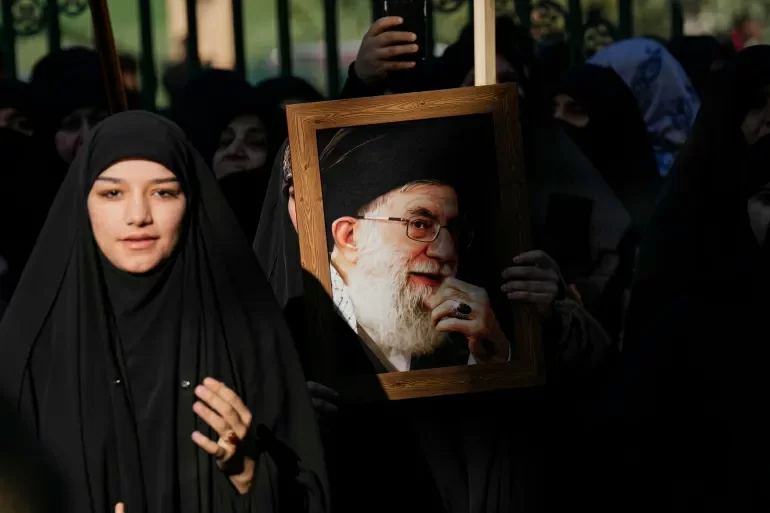
In a seismic geopolitical development, Iranian Supreme Leader Ayatollah Ali Khamenei was confirmed killed during coordinated U.S.-Israeli airstrikes targeting his residential compound on Saturday. President Donald Trump announced that Khamenei and several high-ranking officials “could not evade American intelligence agencies and advanced tracking systems.” Iranian state television subsequently verified the death hours later, confirming the simultaneous fatalities of Khamenei’s daughter, son-in-law, and granddaughter. Iran has declared 40 days of national mourning.
Khamenei’s political trajectory was fundamentally shaped by wartime leadership and profound Western skepticism. Assuming power in 1989 following Ayatollah Ruhollah Khomeini’s death, he transformed from ideological successor to strategic architect of Iran’s military and paramilitary infrastructure. His presidency during the devastating Iran-Iraq War (1980-1988) cemented his distrust of Western powers, particularly the United States, after their support for Saddam Hussein’s regime.
According to Vali Nasr, Iran expert and author of ‘Iran’s Grand Strategy: A Political History,’ Khamenei operated as “a wartime president who emerged from conflict recognizing Iran’s vulnerability and need for security.” This perspective fueled his development of the Islamic Revolutionary Guard Corps (IRGC) from paramilitary force into a dominant security, political, and economic institution. His “resistance economy” concept aimed to achieve self-sufficiency amid crushing Western sanctions.
Khamenei’s tenure faced significant challenges, including the violent suppression of 2009 election protests (the Green Movement) and nationwide demonstrations over women’s rights in 2022. The greatest crisis emerged in January with widespread economic unrest triggering calls to overthrow the Islamic Republic, met by the most severe state violence since the 1979 revolution.
Born in 1939 in Mashhad to an Azerbaijani family, Khamenei began Quranic studies at age four. His theological education in Najaf and Qom brought him under Khomeini’s mentorship, shaping his revolutionary activism against the Shah’s regime. Multiple arrests and exile to Iranshahr preceded his return during the revolution that toppled the Pahlavi monarchy.
Post-revolution, Khamenei served as Defense Minister (1980) and IRGC supervisor before narrowly surviving an assassination attempt and becoming Iran’s first clerical president in 1981. His appointment as Supreme Leader in 1989 occurred despite not meeting traditional qualifications, focusing instead on rebuilding a war-torn nation and strengthening military capabilities.
Khamenei demonstrated occasional pragmatism, supporting the 2015 nuclear deal as tactical arrangement rather than normalization with the U.S. Following America’s withdrawal from the agreement in 2018, he intensified anti-American rhetoric and expanded nuclear activities.
Regionally, Khamenei constructed the “axis of resistance” network including Hezbollah, Assad’s Syria, and Hamas. This alliance recently weakened after intensified strikes on Iranian targets, culminating in the June 2025 U.S.-Israeli attacks on nuclear facilities and military leadership that precipitated retaliatory missile strikes against Israel and American bases.
Khamenei’s legacy remains defined by perpetual resistance to Western influence, unwavering prioritization of national security, and consequential isolation that exacted heavy economic costs on Iran’s population. Despite widespread criticism regarding human rights and suppression of dissent, he established an indelible imprint on contemporary Iranian politics and Middle Eastern geopolitics.