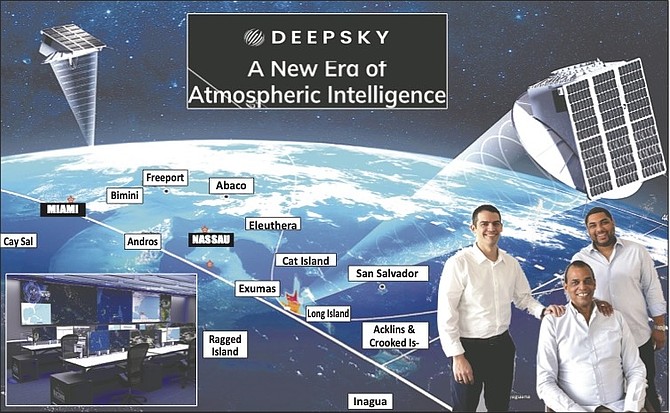
Space technology company Tomorrow.io has unveiled DeepSky, an advanced satellite constellation set to transform global weather data collection and analysis. This announcement comes merely weeks after the successful deployment of their initial satellite network, marking a significant acceleration in their space-based meteorological ambitions.
The groundbreaking system addresses critical limitations in traditional weather forecasting methodologies. For decades, meteorological services worldwide have depended on a sparse network of government-operated satellites characterized by high development costs and limited observational capabilities. This infrastructure has constrained both the frequency and resolution of atmospheric data available to forecasters.
DeepSky represents a paradigm shift in weather observation technology. Operating in low Earth orbit, the new constellation promises enhanced atmospheric data quality, improved revisit rates, and comprehensive global coverage. Rather than supplanting existing government systems, the network is designed to complement them by providing unprecedented temporal density and expanded monitoring capabilities, particularly benefiting regions like The Bahamas and the Caribbean.
Company leadership emphasizes the transformative potential of this development. “Historically, atmospheric radar deployment in space has been exclusively government-led, with only a handful of such systems ever launched,” noted Shimon Elkabetz, CEO and Co-Founder. “With each successful launch, we approach a new era of space-based weather intelligence.”
The timing coincides with the meteorological industry’s rapid transition toward AI-driven forecasting models, which require continuous, high-density data streams for optimal performance. Technological advancements have simultaneously reduced both development timelines and costs for high-performance spacecraft, making commercial satellite constellations increasingly viable.
According to Itai Zlotnik, Co-Founder and Chief Customer Officer, these innovations will enable “unprecedented sub-hourly global weather insights,” significantly improving prediction accuracy during increasingly volatile weather patterns. This enhanced capability could prove crucial for aviation safety, climate monitoring, and severe weather preparedness worldwide.