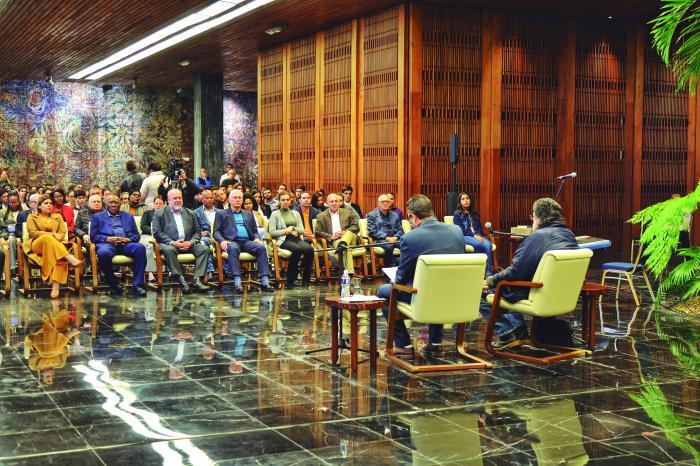
HAVANA – In a ceremony rich with historical symbolism, Cuban President Miguel Díaz-Canel Bermúdez presided over the formal presentation of “Selected Works of Army General Raúl Castro Ruz” at the Palace of the Revolution’s Portocarrero Hall on Tuesday. The event, attended by one hundred carefully selected young Cubans, marked the unveiling of a comprehensive nine-volume collection documenting Castro’s six-decade revolutionary career.
President Díaz-Canel framed the publication as essential reading for contemporary youth, emphasizing its value in “a world where truth is one of the most wounded virtues.” In his prologue to the collection, the Cuban leader characterized Castro as representing “that generation that valued life above all else and fought to defend it, even if it meant his own life.”
The February 24th timing carried profound historical significance, as noted by Dr. Elier Ramírez Cañedo, PhD in Historical Sciences, who co-presented the works alongside Abel Prieto Jiménez, president of Casa de las Américas. The date coincides with multiple pivotal moments in Cuban history: the 1895 resumption of liberation struggles, General Máximo Gómez’s 1899 entry into Havana, the 1956 founding of the Revolutionary Directorate, and the 1976 proclamation of Cuba’s first Socialist Constitution.
Compiled by Ediciones Celia over four years, the collection represents a monumental archival achievement containing more than 500 documents spanning over 5,000 pages, supplemented by extensive scholarly annotations. Each volume incorporates QR technology linking to photographic documentation of Castro at corresponding life stages.
Prieto Jiménez highlighted the collection’s distinctive illumination of Castro’s leadership style, describing it as fundamentally different yet complementary to Fidel Castro’s approach. He emphasized Raúl’s deeply Martí-inspired philosophy, his distinctive colloquial communication style, and his consistent humanism manifested through policies rejecting the humiliation of subordinates.
The presentation attracted Cuba’s highest leadership, including Prime Minister Manuel Marrero Cruz, Organization Secretary Roberto Morales Ojeda, Vice President Salvador Valdés Mesa, and Secretary of the Council of Ministers José Amado Ricardo Guerra—all Political Bureau members.
Simultaneously, at the University of Havana, historians emphasized the collection’s academic significance. Daily Sánchez Lemus, deputy director of the Office of Historical Affairs, noted the deliberate university venue selection, stating the institution traditionally teaches “how to be revolutionaries and to defend the Homeland.” The compilation begins appropriately with Castro’s 1951 article published in Saeta, the university’s publication.
The digital edition has been available for several months through Communist Party platforms and national press outlets, with physical copies distributed to youth representatives from the Vladimir Ilich Lenin Pre-University Vocational Institute and various social sectors.