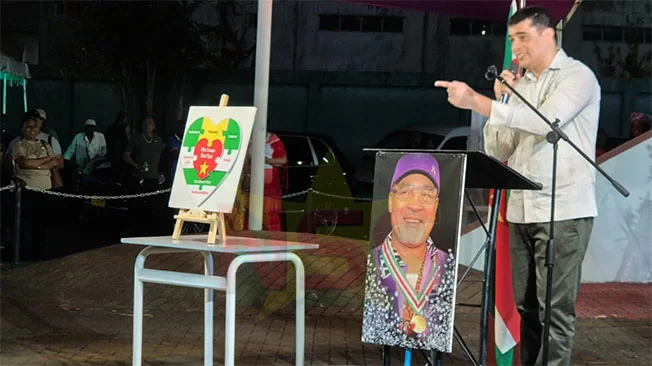
In a politically charged address during Suriname’s commemoration of the February 25, 1980 revolution, National Assembly Speaker and NDP Vice Chairman Ashwin Adhin positioned former leader Desi Bouterse at the center of national discourse. Adhin emerged as a staunch revolutionary advocate, dedicating his entire speech to Bouterse’s political legacy while calling for national unity and hinting at potential legal resolutions for three convicted ex-military personnel.
The assembly speaker characterized the absence of Stephanus Dendoe, Ernst Gefferie, and Benny Brondenstein as a significant loss, revealing that legal ‘pathways’ remain open for their cases. Adhin expressed confidence that President Jennifer Simons would exercise her constitutional authorities appropriately, including potential pardon powers, at the proper time and manner.
Adhin redefined the 1980 revolution as a multicultural, unifying people’s movement that transcended ethnic divisions in Surinamese society. He acknowledged the period’s mixed legacy of achievements and painful moments, emphasizing that meaningful commemoration requires transforming history into acts of unity, discipline, and national development.
In a deeply personal segment, Adhin reflected on his relationship with Bouterse, stating he had not only admired but actively sought to understand and share responsibility for the revolutionary ideology. The speaker emotionally channeled Bouterse’s tradition by singing lines from ‘I Did It My Way’ and Hindi ballad ‘Zara Chahra To Dikhaao,’ symbolizing Bouterse’s political and personal journey.
Linking his message to current political cooperation between former rivals in government, Adhin framed this constellation as a historic opportunity for reconciliation with the past. He warned against increasing polarization while advocating for humanity, discipline, and solidarity as essential conditions for national development and sovereignty protection.
Through his address, Adhin imbued the revolution anniversary with distinct political significance, explicitly connecting Bouterse’s legacy, revolutionary heritage, and contemporary constitutional questions within Suriname’s ongoing political narrative.