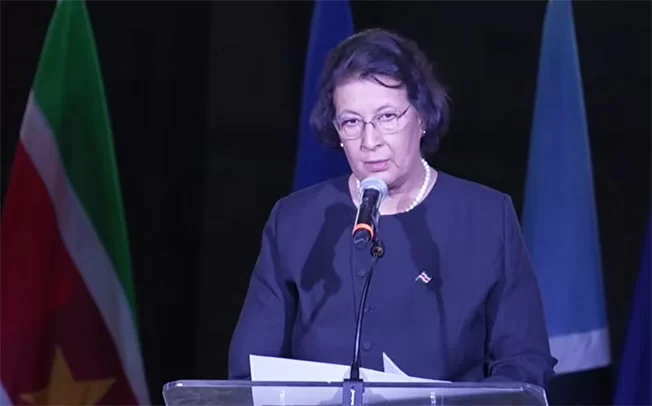
Surinamese President Jennifer Simons delivered her inaugural address as head of state during the 50th Regular Meeting of the Conference of Heads of Government of CARICOM in St. Kitts and Nevis, outlining a visionary agenda for Caribbean regional cooperation. The historic speech marked her first appearance at the premier regional forum since assuming office seven months ago as Suriname’s first female president.
In her opening remarks, President Simons extended congratulations to Prime Minister Terrance Drew of St. Kitts and Nevis on assuming the CARICOM chairmanship while expressing appreciation for the leadership of outgoing chair, Jamaican Prime Minister Andrew Holness.
Emphasizing the familial nature of the Caribbean community, President Simons asserted that “CARICOM is not merely an institution; it is a family.” Against the backdrop of global economic uncertainty, climate change, geopolitical shifts, and social pressures, she framed regional unity not as an optional approach but as an essential requirement for small states to maintain influence and enhance resilience.
A substantial portion of her address focused on youth development, education, and technological advancement. President Simons highlighted how today’s youth navigate a world fundamentally different from previous generations, characterized by rapid digitalization, artificial intelligence, and green transition developments. She advocated for educational systems that equip young people with digital literacy, entrepreneurial skills, and adaptive capabilities, positioning youth empowerment as central to regional policy-making in innovation, technology, and social inclusion.
Addressing Suriname’s emerging oil and gas sector, the president positioned energy resources as catalysts rather than endpoints for development. Within the global energy transition framework, she committed Suriname’s contribution to regional energy security while emphasizing strategic reinvestment of hydrocarbon revenues into economic diversification and environmental protection to ensure post-sector economic resilience.
President Simons identified climate change as an existential reality for the region, with rising sea levels, extreme weather events, and food insecurity disproportionately affecting Caribbean nations. She advocated for equitable and accessible climate financing for small island and low-lying states, noting Suriname’s unique carbon-negative status through its extensive forests absorbing more CO₂ than the country emits. The president called for collective CARICOM advocacy toward just climate financing mechanisms.
In her concluding remarks, President Simons urged fellow heads of state and government to demonstrate the courage and determination necessary to guide the region through challenging times, expressing hope that the conference would yield clear strategies and renewed shared responsibility.
This maiden speech at CARICOM’s highest regional platform positions Suriname under President Simons’ leadership as a constructive partner focused on youth empowerment, sustainable energy development, regional cooperation, and climate justice advocacy.