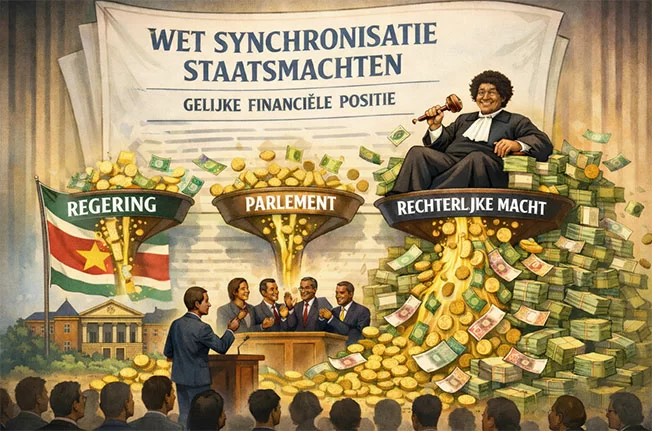
A contentious debate has erupted in Suriname regarding the substantial compensation packages for members of the judiciary, with the Prosecutor General now receiving over SRD 1 million annually. This development has sparked widespread public outrage and raised fundamental questions about legislative integrity and political priorities.
Rather than an isolated oversight, investigation reveals this situation resulted from deliberate legislative choices embedded within the Judicial Position Law. Political figures, particularly members of the previous parliament, have engaged in extensive maneuvers to defend the legislation that enabled these substantial judicial salaries. Initial proponent Asis Gajadien (VHP) has acknowledged potential errors requiring correction, yet stops short of admitting fundamental flaws in the law’s conception. Co-initiator Geneviévre Jordan (ABOP) has maintained complete silence since public discontent surfaced.
This controversy highlights a persistent pattern within Suriname’s legislative culture where laws frequently pass without adequate societal review. Many legislation pieces lack economic realism, contain linguistic deficiencies, and employ complex terminology that challenges even implementing agencies.
The judicial compensation issue raises broader concerns about parliamentary intentions and priorities. Parliamentary leadership demonstrates remarkable eagerness to advance legislation benefiting high-ranking public officials while crucial workforce sectors including teachers, nurses, and healthcare professionals face persistent uncertainty regarding compensation and working conditions.
The fundamental competency question emerges: how could multiple reviewing institutions fail to identify the complete lack of societal balance and unacceptable injustice toward the public? The responsibility ultimately rests with both parliament and government, who approve and enact legislation.
The response to whistleblower Eugène van der San’s revelations proved particularly revealing. Rather than accepting responsibility, critics attacked the messenger and framed the exposure as a political assault against the Prosecutor General, effectively diverting attention from the core issue: how such legislation could emerge in the first place.
This situation forces citizens to question whether parliamentarians truly represent public interests or merely advance party agendas. Under the guise of synchronizing state powers—a promise that remains unfulfilled—the produced legislation primarily secures financial advantages for judicial members during and after their service.
Large segments of society perceive this disparity as morally unethical and unjust, creating a perception that political interests outweigh public responsibility. This case must not conclude quietly—laws can be revised, repaired, or revoked, but more importantly, accountability must be presented to society. Transparency and responsibility constitute democratic obligations rather than political options, and both parliament and government must now demonstrate whom they truly represent.