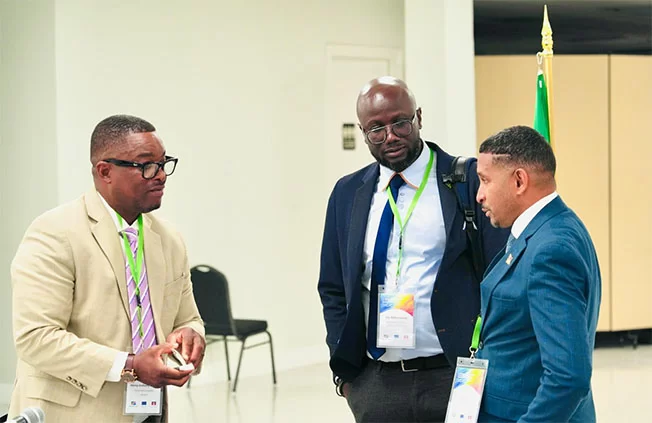
Suriname has emerged as a vocal advocate for climate justice and fair compensation mechanisms during the recent Parliamentary Assembly of the Organization of African, Caribbean, and Pacific States (OACPS) in Antigua. Leading the delegation, Parliamentarian Ebu Jones presented a compelling case for nations that contribute significantly to global carbon storage while facing disproportionate climate impacts.
Jones emphasized Suriname’s unique environmental status as one of the world’s few carbon-negative countries, with over 93% of its territory covered by tropical rainforests that serve as among the planet’s most efficient natural carbon sinks. “We are not part of the climate problem but rather the solution,” Jones declared, highlighting the paradox of a nation that “cools the Earth while warming under the pressure of climate injustice.”
The parliamentarian drew attention to Suriname’s vulnerability as a low-lying coastal nation where most of the population resides, facing increasing risks from sea-level rise and extreme weather events. He identified what he termed “structural climate injustice” – where Suriname provides essential global ecological services without receiving adequate compensation.
Jones called for the establishment of robust and transparent carbon credit markets, arguing that standing forests should be recognized not as “empty lands” but as measurable and valuable global assets. “If the world benefits from our forests, the world must invest in their preservation,” he asserted, demanding that climate finance evolve from symbolic commitments to structural redistribution.
Beyond financial mechanisms, Suriname requested concrete implementation of technological cooperation in renewable energy, water management, and disaster resilience. Jones emphasized that “a just energy transition is impossible without technological justice.”
Domestically, Suriname is undertaking significant institutional reforms to embed sustainability principles. These include modernizing anti-deforestation legislation, enhancing nature conservation efforts, and developing a transparent national carbon credit framework. Notably, the country has merged energy development and environmental management under a single ministry portfolio – the Ministry of Oil, Gas, and Environment – ensuring that resource exploitation and ecological responsibility are guided by a unified national compass.
The Surinamese delegation, which included Assembly members Ronny Asabina (BEP) and Dewanchandrebhose Sharman (VHP), demonstrated the importance of active parliamentary diplomacy and strengthening the Caribbean voice within the broader OACPS-EU partnership. Jones called for regional unity, stating that “coastal erosion respects no borders, hurricanes recognize no sovereignty. Climate risk is shared, therefore our strategy must be shared.”
In his concluding remarks, Jones challenged the OACPS assembly to move beyond declarations and “dare to demand a climate finance architecture rooted in justice. Dare to reward protection rather than destruction. Carbon-negative countries are not peripheral players – we are pillars of planetary stability.”