Amid escalating military deployments and fragile diplomatic negotiations, the United States has intensified pressure on Iran to reach a comprehensive agreement while simultaneously bolstering its military presence in the Middle East. White House spokeswoman Karoline Leavitt declared it would be “highly prudent” for Iran to accept a deal with the Trump administration, following the second round of indirect nuclear talks held in Geneva.
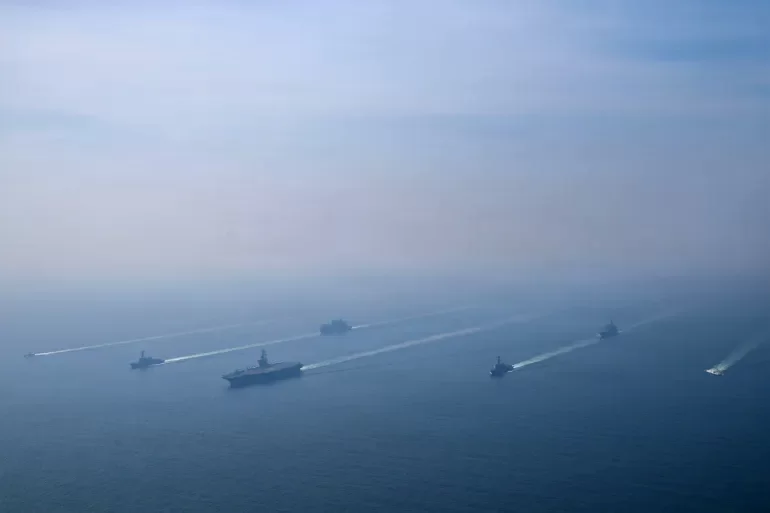
The Pentagon has significantly enhanced its regional capabilities, deploying two aircraft carriers, multiple destroyers, and advanced fighter aircraft including F-22 Raptors and F-15s. This military reinforcement has raised concerns about potential conflict escalation, particularly as Iranian Revolutionary Guards conducted demonstration exercises in the strategic Strait of Hormuz.
Geneva negotiations proceeded with considerable difficulties. While Iranian officials referenced progress on “guiding principles,” US Vice President JD Vance maintained that Tehran had not yet met all of Washington’s “red lines.” Chief negotiator Vladimir Medinsky characterized the discussions as “challenging yet businesslike.”
President Donald Trump has repeatedly threatened military action against Iran, referencing Tehran’s harsh crackdown on protests last month. In a notable expansion of rhetoric, Trump also cautioned British Prime Minister Keir Starmer regarding any agreement on the Chagos Islands, emphasizing the strategic importance of the US Air Force base at Diego Garcia for potential operations against Iran.
Iranian President Masoud Pezeshkian asserted Wednesday that his nation “seeks no war” but would not submit to what he termed “humiliating” American demands. Supreme Leader Ayatollah Ali Khamenei previously warned that new US attacks would trigger broader regional escalation.
The core dispute remains Iran’s nuclear program, which Tehran maintains is strictly civilian and subject to concessions in exchange for sanctions relief. The US continues to demand restrictions on Iran’s ballistic missile program—a condition Iran finds unacceptable.
Negotiations were led by US envoy Steve Witkoff and Jared Kushner, Trump’s son-in-law, with continued United Nations involvement. Iranian diplomat Abbas Araghchi met with Rafael Grossi, head of the UN nuclear watchdog, to discuss frameworks for future dialogue.
Since Trump’s 2018 withdrawal from the JCPOA nuclear agreement and implementation of maximum pressure sanctions, attempts to forge new agreements have repeatedly stalled. The current military buildup and diplomatic stalemate have created heightened uncertainty about peaceful resolution prospects.