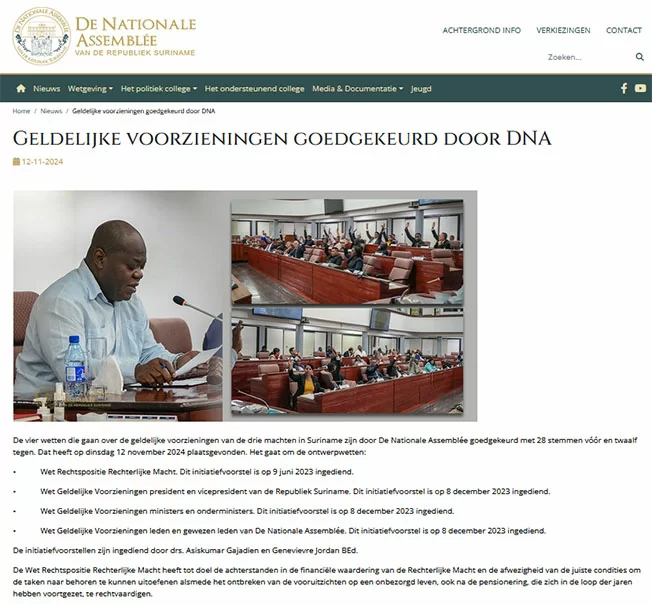
A legislative package hailed in November 2024 as a historic correction of constitutional omissions since 1975 has been revealed as a fundamental restructuring of state income distribution that systematically benefits top officials. Under the misleading label of ‘synchronization,’ four laws governing remuneration for judiciary, presidential, vice-presidential, ministerial, and parliamentary positions created a system that disproportionately favors elite ranks while increasing state fiscal burdens and undermining public trust.
The legislation, promoted by initiators Asis Gajadien (VHP) and Geneviévre Jordan (ABOP) with coalition support, was morally justified as eliminating double salaries, reducing privileges, raising retirement ages, promoting transparency, and improving state finances. However, instead of harmonization or savings, the laws engineered a dynamic income explosion at the top while leaving the rest of the state apparatus behind.
Critical flaws emerged during parliamentary scrutiny. Opposition parties (NDP, BEP, NPS) repeatedly requested comprehensive financial impact assessments, multi-year projections, and scenario analyses incorporating periodic increments, service years, pension accruals, and tax exemptions. No independent financial evaluation or objective HRM valuation study comparing international benchmarks was presented before the vote, which passed with support from VHP, ABOP, PL, and BEP.
The judicial compensation structure reveals the systemic bias: judges receive annual 5% increments, full credit for prior service years, pension structures reaching 100% of baseline salary, and tax exemptions on high allowances—benefits entirely absent from presidential compensation. This creates an asymmetrical growth mechanism where senior judicial officials with decades of service rapidly outpace their theoretical reference point (presidential salary), with some exceeding 500,000 SRD—multiple times the head of state’s remuneration.
When public administrator Eugène van der San published calculations revealing these disparities, his analysis was initially dismissed as exaggerated. Subsequent official publications of salary scales and pay stubs confirmed net incomes far exceeded amounts suggested during parliamentary debates. Rather than acknowledging underestimation, initiators denied the discrepancies, exacerbating the credibility crisis.
The laws were adopted while civil servants received minimal raises, teachers faced shortages and backlogs, healthcare workers operated under extreme pressure, and parliamentary support staff earned fractions of top-tier compensation. The state income structure has transformed from balanced hierarchy to disproportionate tower, with completely skewed ratios between national leadership and public workers.
Unanswered questions demand immediate resolution: total budgetary impact over ten years including increments and pension obligations; cumulative salary increases across government branches; ratio between top incomes and average civil service wages; and why no independent financial simulation was presented before voting. Without transparent answers, suspicion remains that legislation was manipulated to structurally benefit elites.
Presented as historic ordering before Suriname’s fiftieth independence anniversary, these laws risk becoming a historic error without correction. While judiciary deserves dignified legal status, the current consequences are morally unacceptable and socially unsustainable. If parliament fails to address this, society will correct parliament—typically through less friendly means. Trust in politics has drastically declined through this ‘synchronization’ process, awaiting concrete steps to rectify what many perceive as institutionalized self-enrichment.