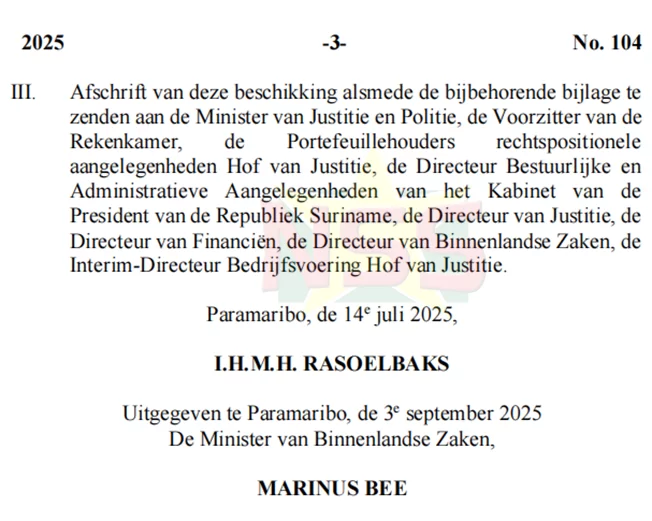
Suriname has implemented a comprehensive salary restructuring for judicial officials that has ignited significant public and political discourse. The new compensation framework, formally established through Court of Justice President’s directive on July 14, 2025, and detailed in State Decree No. 104 of 2025, creates a remuneration system where judiciary members now earn substantially more than the country’s president.
The compensation structure, jointly endorsed on September 3 by Court President Iwan Rasoelbaks and Interior Minister Marinus Bee—who previously served as Assembly Speaker when the legislation passed in November 2024—introduces progressive salary scales with periodic 5% annual increments extending through 35 years of service.
According to the decree’s annex, the President of the Court of Justice will receive a starting monthly salary of SRD 123,845, potentially reaching over SRD 600,000 at maximum scale. The Vice President’s compensation begins at SRD 105,289 (85% of presidential scale) with ceiling earnings exceeding SRD 510,000. Judges commence between SRD 48,000-65,000 monthly (50-55% scale) with maximum potential earnings of SRD 250,000-300,000, while junior/senior category members start at SRD 76,000-96,000 (62-70% scale) rising to approximately SRD 430,000.
The substantial increases have prompted scrutiny from legislators including NPS assembly member Poetini Atompai, who has raised concerns regarding proportionality, reasonableness, and budgetary implications. Critical questions have emerged about gross salaries per position, total monthly state expenditures, comparative compensation with other government officials, and pre-adjustment compensation levels.
Further attention emerged through Eugène van der San’s disclosure of the Prosecutor General’s remuneration documents, generating additional public inquiry about overall income structures within the judiciary. The legal foundation rests upon the amended Judicial Remuneration Act passed in November 2024, supplemented by the Court President’s July 2025 directive and the September State Decree.