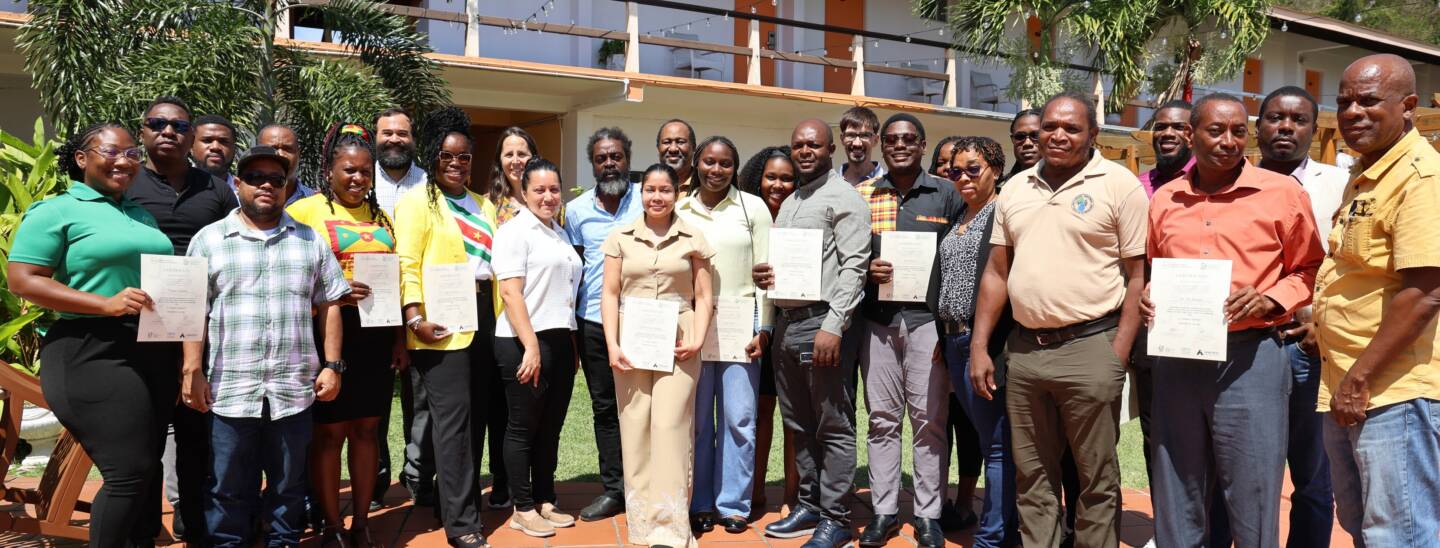
Environmental specialists and Geographic Information System (GIS) professionals from Caribbean Small Island Developing States (CSIDS) have completed an intensive capacity-building program focused on advanced data methodologies for land degradation assessment. The specialized training, conducted in Grenada, equipped participants with cutting-edge tools for the 2026 Reporting on Performance Review and Assessment of Implementation System (PRAIS 4).
The week-long workshop, concluding on February 6, 2026, in St. George’s, was orchestrated by the Partnership Initiative for Sustainable Land Management (PISLM) with multilateral support from the United Nations Convention to Combat Desertification Secretariat, financial backing from the Global Environment Facility (GEF), implementation through the United Nations Environment Programme (UNEP), and technical delivery collaboration with APACHETA.
Suriname’s PRAIS Reporting Officer Zylenna Darson emphasized the transformative impact of moving beyond generic global datasets. “This initiative enabled crucial validation of our national environmental data,” Darson noted. “Previously dependent on default information that frequently misrepresented actual conditions, we can now achieve substantially more accurate depictions of land degradation.”
The training facilitated cross-border knowledge exchange, allowing professionals from multiple Caribbean nations to develop collaborative strategies for sustainable land management. St. Kitts and Nevis GIS Officer Ayodele DeCosta highlighted how the workshop addressed the historical generalization of small island reporting, enabling more precise monitoring of environmental challenges.
Haiti’s UNCCD Focal Point Eder Audate connected the training to recent national advancements, stating that the recently completed soil survey combined with these new capabilities would significantly enhance land degradation combat efforts.
Bahamian representatives Latonya Williams and Jenny Morris expressed confidence that the high-resolution data methodologies would directly inform future environmental policies and project development.
PISLM leadership encouraged participants to extend the application of these tools beyond immediate reporting requirements, emphasizing their potential to strengthen regional environmental policies, accurately document national achievements, and promote sustainable development resilience throughout the Caribbean region.