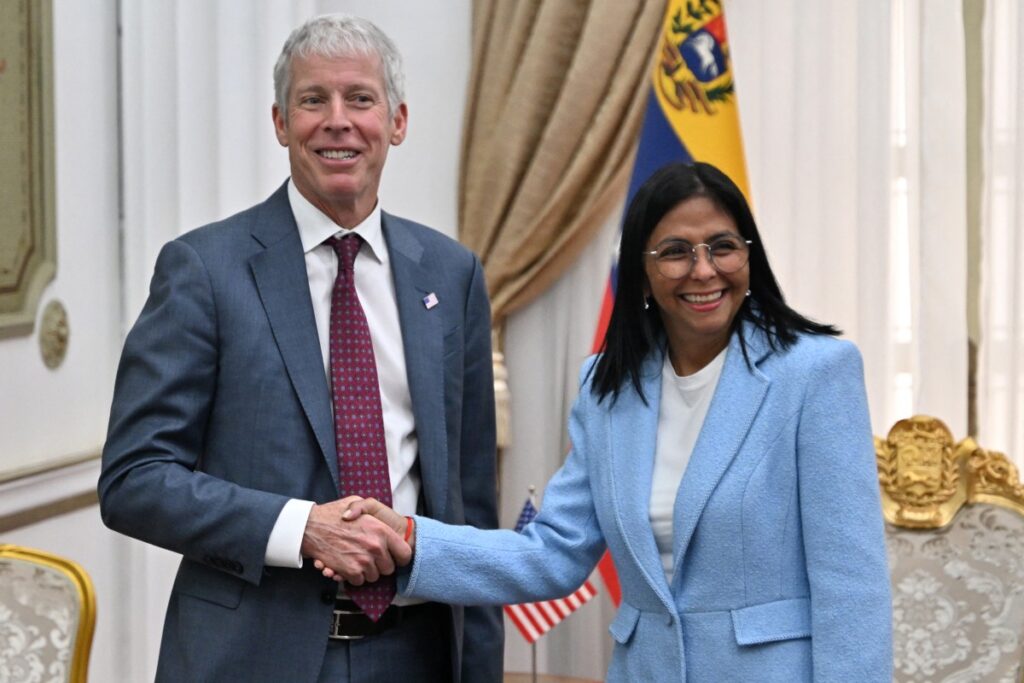
CARACAS, Venezuela — In a significant diplomatic overture, United States Energy Secretary Chris Wright conducted high-level discussions in Caracas on Wednesday with Venezuela’s acting president Delcy Rodríguez and key oil industry executives. The landmark meeting focused on strategies to revitalize Venezuela’s enormous crude oil reserves, which rank as the world’s largest.
This visit represents the most senior Trump administration official to enter Venezuela since US special forces orchestrated the overthrow of socialist leader Nicolás Maduro on January 3. President Trump has conditionally endorsed Rodríguez as interim leader, contingent upon her administration complying with Washington’s requirements including granting US access to Venezuelan petroleum resources and reducing state-sponsored repression.
The US Embassy publicly welcomed Wright’s arrival via social media, stating: “Your visit is key to advancing @POTUS’s vision of a prosperous Venezuela.” The embassy further emphasized that American private sector involvement would be “essential to boost the oil sector, modernize the electric grid, and unlock Venezuela’s enormous potential.” Official photographs captured Wright’s arrival at Maiquetía International Airport alongside Laura Dogu, the newly appointed US chargé d’affaires in Venezuela.
According to the US Department of Energy, Wright’s itinerary included inspections of Venezuelan oil fields as part of efforts to “advance President Trump’s mission to restore prosperity, safety, and security for Venezuela, the United States, and the entire Western Hemisphere.”
Venezuela’s oil industry presents both extraordinary potential and formidable challenges. The nation possesses proven reserves exceeding 303 billion barrels—approximately one-fifth of global oil reserves—according to OPEC data. However, years of chronic underinvestment, economic mismanagement, and international sanctions have crippled production capabilities. By 2024, Venezuela’s output had dwindled to merely one percent of worldwide crude production.
Recent developments have created new opportunities for cooperation. The Trump administration relaxed sanctions on Venezuelan oil last month following Rodríguez’s implementation of legislation opening the state-controlled energy sector to private investment. President Trump has articulated ambitions for US oil corporations to rapidly reconstruct Venezuela’s energy infrastructure and increase production by millions of barrels daily.
Trump has proposed a profit-sharing arrangement, stating: “We’re going to be selling a lot of oil, and we’ll take some, and they’ll take a lot. They’re going to make more money than they’ve ever made, and it’s going to be beneficial to us.”
Energy Secretary Wright praised Venezuela’s newly enacted hydrocarbons law in recent comments to Politico, describing the legislation as “a gesture of improvement already very early on in this new relationship between the US and Venezuela.” He added that both governments “want to see investment coming into Venezuela.”
The US Treasury Department reinforced this diplomatic shift on Tuesday by issuing licenses permitting certain transactions involving Venezuela’s government and state oil company PDVSA. These authorizations specifically enable provisions of goods, technology, and software essential for oil and gas exploration, development, and production.
Despite these developments, significant obstacles remain. Potential investors face persistent political instability, security concerns, and the substantial capital requirements needed to restore production capacity in a deteriorated energy sector.