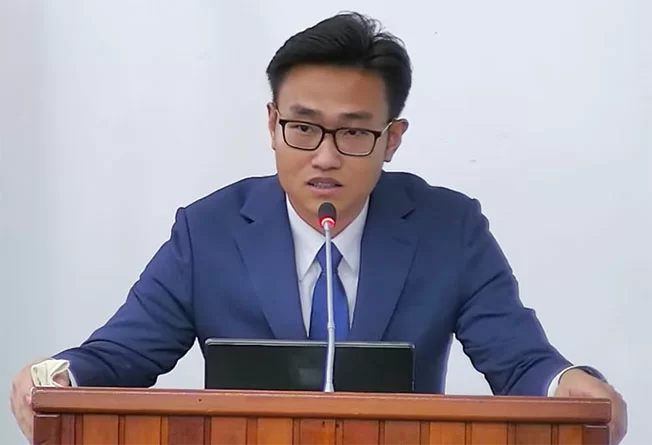
In a significant address to the National Assembly on Friday, Assembly member Xiaobao Zheng of the Pertjajah Luhur party presented a comprehensive case for judicial reform, emphasizing the urgent need to strengthen Suriname’s rule of law framework. As co-initiator of the proposed measures, Zheng clarified that these reforms are institutionally focused rather than personally targeted, designed specifically to align the nation’s legal systems with international standards.
The assembly member first addressed the proposed constitutional amendment recognizing indigenous peoples as Suriname’s original inhabitants. Zheng explained this amendment not only provides constitutional acknowledgment but also fulfills Suriname’s obligations under international treaties. “This constitutional change facilitates the national implementation of international commitments concerning the protection and recognition of indigenous peoples’ rights,” he stated.
Zheng then turned to the introduction of cassation jurisprudence, highlighting how Suriname currently lags internationally with a judicial system that features only one appellate instance. Under the present structure, the Cantonal Court serves as the first instance while the Court of Justice functions as the appellate body. Zheng argued this structure is insufficient, noting that most international systems maintain at least two appellate instances. The proposed third judicial tier would review whether the Court of Justice has applied law correctly, thereby enhancing legal certainty and jurisprudential development.
The proposal to establish a College of Attorney General also received detailed attention. Zheng stressed this initiative aims to holistically strengthen the Public Prosecutor’s Office rather than target any individual. He noted the Attorney General currently manages an extensive portfolio including criminal investigation, prosecution, sentence execution, leadership of the Public Prosecutor’s Office, and combating serious crime. “Concerns exist not only about excessive power concentration in a single Attorney General but also about an overwhelming accumulation of responsibilities within one office,” Zheng contended.
The assembly member emphasized that prosecutorial independence is paramount, requiring judgments based solely on law and facts without political interference. To reinforce this independence and effectiveness, Zheng deemed a collective model essential. This approach would not only distribute workload more effectively but also improve the quality and continuity of the Public Prosecutor’s Office’s functioning.
Zheng underscored that these proposed legal amendments form part of a broader rule of law reform package intended to strengthen Suriname both juridically and institutionally. He expressed openness to questions and further discussion regarding implementation feasibility but maintained that institutional strengthening constitutes the necessary first step, with subsequent legislative elaboration to follow.