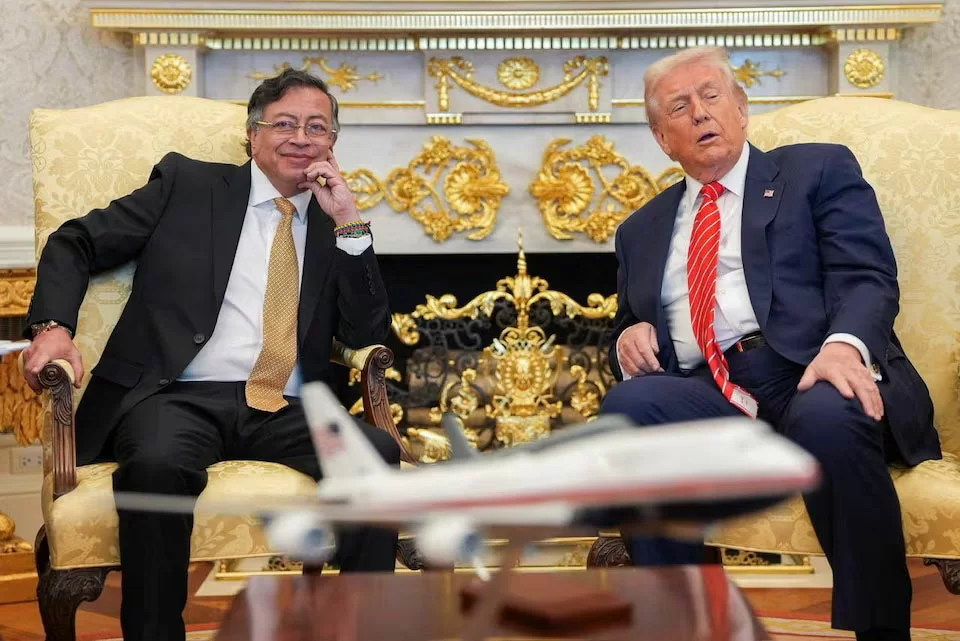
In a remarkable diplomatic turnaround, U.S. President Donald Trump and Colombian President Gustavo Petro convened for an unexpectedly cordial two-hour private meeting at the Oval Office on Tuesday, marking their first face-to-face engagement amid previously strained relations.
The closed-door discussion, conducted without media presence, yielded positive assessments from both leaders despite months of public acrimony. President Trump confirmed collaborative efforts to combat drug trafficking from Colombia, stating, ‘We were working together and it clicked. We were never friends because I didn’t know him, but I didn’t feel insulted.’
President Petro subsequently shared on social media platform X a photograph featuring Trump’s handwritten note: ‘Gustavo – a great honor – I love Colombia.’ In interviews with Colombian radio network Caracol, Petro emphasized that their ideological differences proved less significant than media portrayals had suggested.
The Colombian leader presented specific requests during the meeting, seeking U.S. assistance in locating major drug criminals operating beyond Colombia’s borders. Additionally, Petro asked Trump to mediate an ongoing diplomatic dispute between Colombia and Ecuador, whose president maintains strong allegiance to the U.S. administration. According to Petro, Trump agreed to initiate contact with Ecuadorian President Daniel Noboa.
This diplomatic engagement represents a substantial shift from previous exchanges. In October, Trump had baselessly labeled Petro an ‘illegal drug trafficker’ and earlier this year suggested potential military action against Colombia. Petro had conversely criticized U.S. military interventions throughout Latin America.
The Washington meeting follows an unexpectedly positive telephone conversation in January, signaling gradual reconciliation. Petro even complimented the recent refurbishment of the Oval Office, particularly noting its gold accent features.
Outstanding issues remain unresolved, including U.S. sanctions against Petro himself due to unproven allegations of drug trade connections—claims the Colombian president vehemently denies.
Regional security analysts note that failed reconciliation could have severe consequences for regional stability. As the world’s largest producer of coca—the primary ingredient for cocaine—Colombia hosts multiple U.S.-designated terrorist organizations while simultaneously serving as a crucial U.S. ally in anti-narcotics operations.
Under Petro’s administration, coca production has increased according to some metrics, though interpretations vary. Colombia has shifted from forced eradication policies toward more sophisticated interception mechanisms and seizure operations.
The meeting occurred against a complex backdrop: Last week, Petro urged Colombian migrants in Chile, Argentina, and the United States to return home to avoid ‘slave-like’ treatment abroad. He also declared he would prefer residing in Havana over Miami, which he characterized as traffic-congested and culturally deficient.