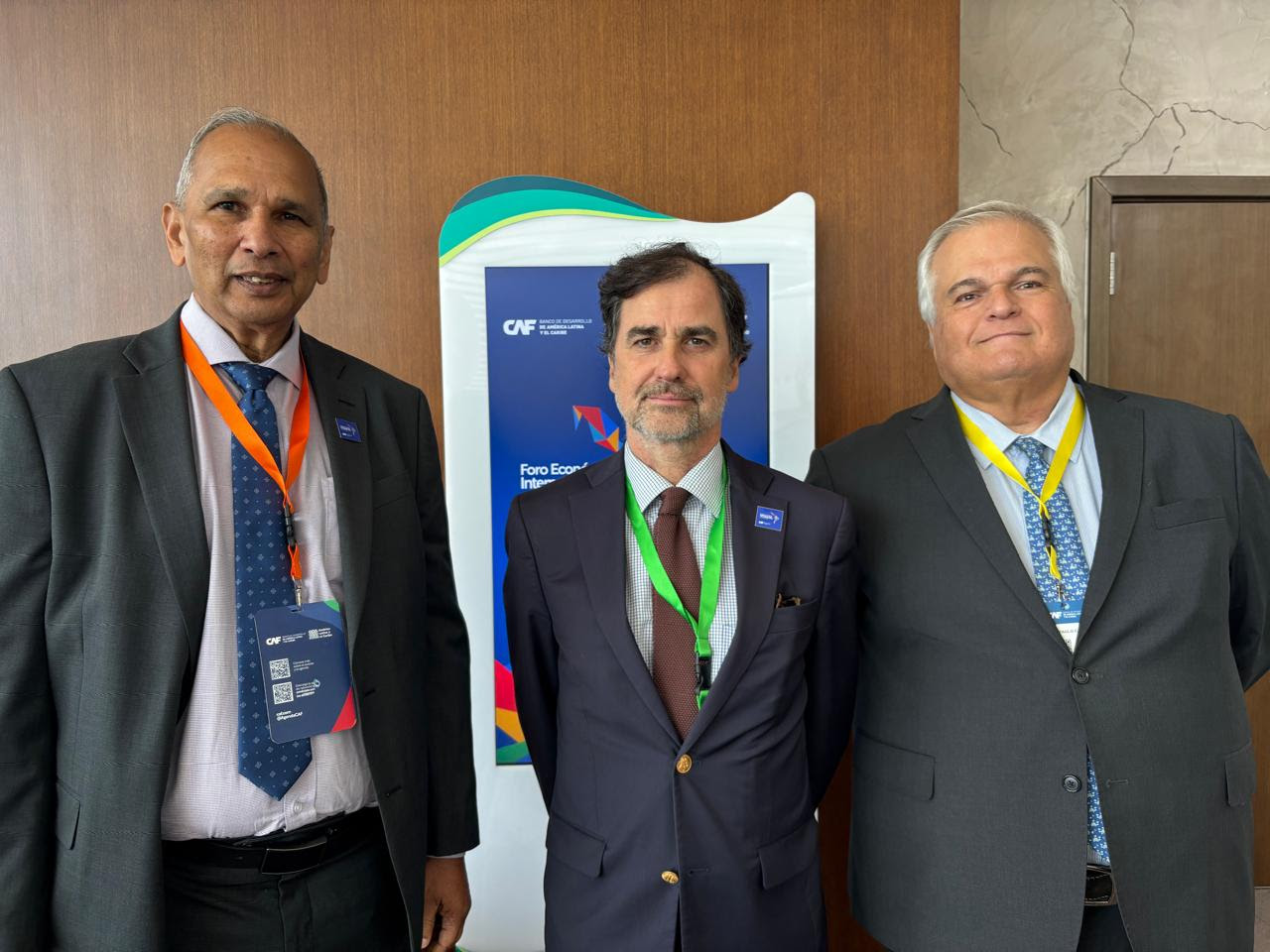
In a significant development for hemispheric agriculture, the Inter-American Institute for Cooperation on Agriculture (IICA) and CAF – Development Bank of Latin America and the Caribbean have established a strengthened partnership to address critical funding gaps in the agricultural sector. The alliance was formalized during the International Economic Forum for Latin America and the Caribbean 2026 in Panama City, where IICA Director General Muhammad Ibrahim met with CAF Executive President Sergio Díaz Granados and Vice President Christian Asinelli.
The high-level meeting, attended by numerous heads of state and government ministers, focused on creating innovative synergies between the development bank and the specialized agricultural agency. Key discussion areas included health initiatives, soil restoration projects, water resource management, and development programs for specific crops. Díaz Granados outlined CAF’s ambitious Agricultural Prosperity Strategy, which aims to provide $8.5 billion in financing by 2030 with emphasis on social and territorial inclusion.
Director General Ibrahim, who assumed his position in January 2026, emphasized the urgent need to bridge the financial divide preventing widespread adoption of agricultural technologies. “Clearly, input costs are rising, and this affects competitiveness,” Ibrahim stated during forum sessions. “Financial considerations must be a central component of any strategy aimed at transforming food systems to satisfy increasing demands.”
The IICA leader detailed how the organization has been developing innovative programs to provide guarantees helping small farmers overcome credit access barriers. He explained that while science offers numerous solutions to boost productivity and improve resilience, many cannot advance beyond initial stages due to financing limitations, inadequate regulatory frameworks, and insufficient infrastructure.
CAF Vice President Asinelli highlighted IICA’s pivotal role in reinforcing Latin America and the Caribbean’s position as a solution to global challenges, noting that agriculture remains a structural mainstay of regional economies despite financial obstacles affecting productivity.
Beyond the CAF meetings, Director General Ibrahim engaged in multiple bilateral discussions with regional leaders including Jamaica’s Minister of Industry, Investment and Commerce Aubyn Hill, Panama’s Ambassador to the OAS Ana Irene Delgado, and Portuguese Parliament Member Paulo Neves, who also serves as President of the Institute for the Promotion of Latin America and the Caribbean in Portugal.
During the forum’s panel discussions, particularly the session on “Agriculture and Food for the Sustainable Transformation of Latin America and the Caribbean,” Ibrahim advocated for stronger alliances between scientific and financial stakeholders. He emphasized the need to develop diverse financial mechanisms that account for the realities small farmers face while promoting sustainable food production systems and accessible healthy diets.