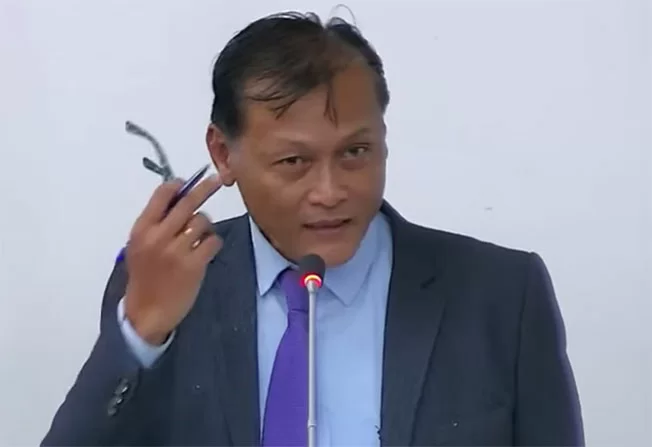
In a landmark address to De Nationale Assemblee, Assembly Member Raymond Sapoen (NDP) positioned ongoing deliberations on judicial and prosecutorial reforms within the broader framework of constitutional governance. Emphasizing the Constitution’s role as the supreme law safeguarding civil rights and separation of powers, Sapoen characterized the current parliamentary deliberations as ‘historic’ for involving all state powers in modernizing Suriname’s justice system.
Regarding the proposed cassation (supreme judicial) instance, Sapoen acknowledged widespread legal community support for a third judicial tier beyond appeals. He referenced societal concerns about judicial verdicts’ quality, independence, and reliability as drivers for reform. However, he criticized the explanatory memorandum accompanying the proposals as insufficient, stressing that such transformative changes require detailed justification regarding necessity and integration into Suriname’s legal architecture.
Notably, Sapoen advocated for constitutional flexibility by defining the supreme judicial body as a ‘highest judicial instance’ for legal violation reviews without pre-committing to a specific model. This approach retains options for regional solutions like the Caribbean Court of Justice (CCJ), potentially with specialized Surinamese civil law chambers, though he emphasized this requires thorough study and political preparation.
The parliamentarian raised substantive questions about proposed amendments to Article 139 concerning the Court of Justice’s oversight of case processing, demanding clarity on alternative supervisory models. He also highlighted constitutional inconsistencies in appointing prosecutors-general, noting discrepancies between constitutional provisions and 2024 judicial status legislation that must be resolved with constitutional primacy.
On retirement age, Sapoen supported reinstating the pension age of 65 for standing magistrates (including prosecutors-general) as a systemic correction to reestablish functional distinction between prosecution and judiciary rather than personalizing the debate.
While expressing theoretical support for a College of Prosecutors-General to mitigate concentration risks in small societies, he criticized the proposal’s lack of justification for member numbers and advocated odd-numbered compositions for decisiveness.
Sapoen concluded by emphasizing that cassation establishment must not divert resources from strengthening first and second instance courts, maintaining that institutional capacity building remains a perpetual government obligation.