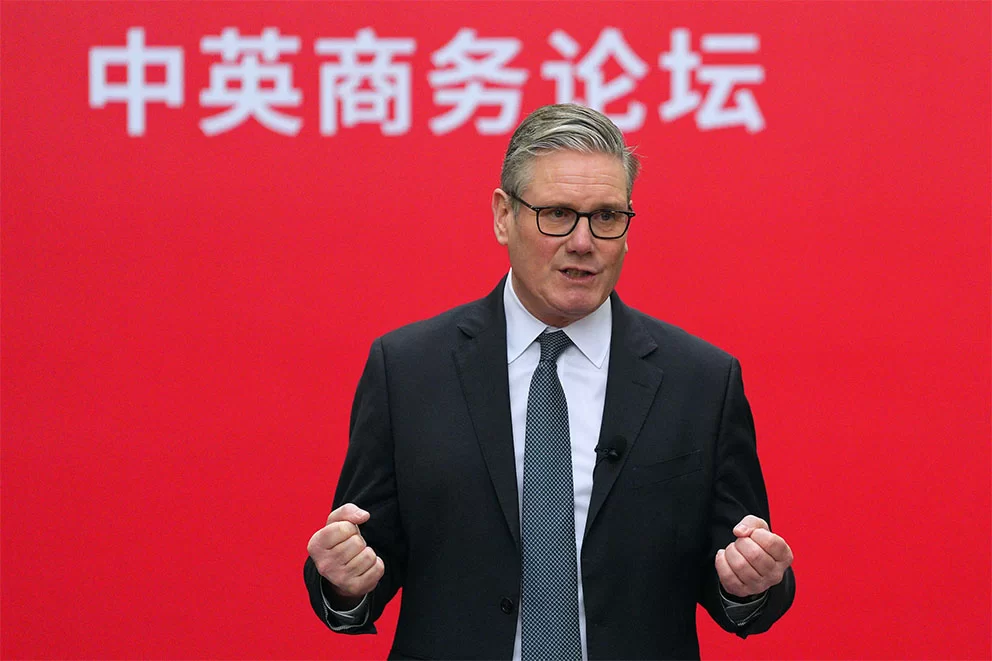
British Prime Minister Keir Starmer concluded a landmark visit to China on Friday, marking the first official trip by a UK leader to Shanghai and Beijing in eight years. Accompanied by over fifty business executives seeking economic opportunities, Starmer’s mission focused on revitalizing trade relations with the world’s second-largest economy.
The diplomatic engagement drew immediate criticism from US President Donald Trump, who characterized UK-China trade negotiations as ‘dangerous.’ Starmer countered that Trump’s remarks were primarily directed at Canada, not Britain, and revealed that Washington had been notified in advance about his visit. He further noted the irony of Trump’s criticism given the US president’s own planned spring visit to China.
During high-level talks in Beijing, Starmer met with President Xi Jinping, with both leaders committing to establish a ‘long-term, stable strategic relationship.’ This development signals a potential thaw in Sino-British relations following years of diplomatic tensions over human rights issues and trade disputes.
A significant breakthrough emerged regarding travel restrictions on British parliamentarians. China agreed to lift bans imposed after the UK, alongside EU, Canadian, and US allies, sanctioned four Chinese officials over human rights violations against Uyghurs in Xinjiang. Starmer characterized this as addressing ‘a point of concern in Parliament,’ while Chinese officials framed it as part of normalizing parliamentary exchanges.
However, controversy emerged as affected British lawmakers, including former Conservative leader Iain Duncan Smith, denied any quid pro quo arrangement involving sanction relief. In a joint statement, they emphasized they would ‘rather remain under sanctions than make concessions to those responsible for genocide in Xinjiang.’
Starmer defended his engagement strategy, telling Sky News: ‘It is not wise for the United Kingdom to bury its head in the sand. China is the world’s second-largest economy and, together with Hong Kong, our third-largest trading partner. This visit opens numerous possibilities for jobs and prosperity.’