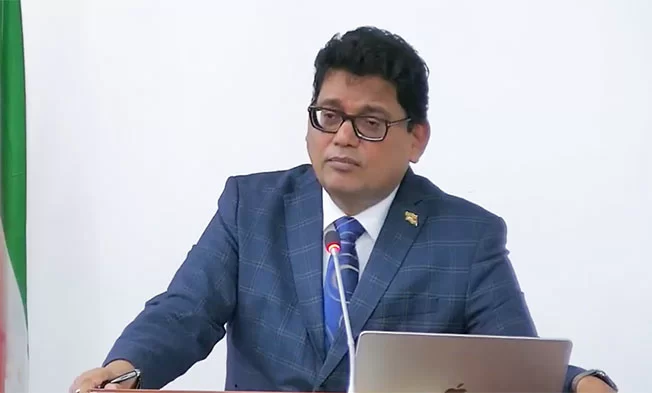
In a significant parliamentary address on Thursday, VHP faction leader Asis Gajadien articulated his party’s firm position regarding Suriname’s judicial modernization efforts. The VHP has decisively rejected the immediate establishment of a national Supreme Court in favor of joining the Caribbean Court of Justice (CCJ) as the country’s third judicial instance.
Gajadien, who serves on the committee of rapporteurs, emphasized that Suriname must prioritize strengthening the foundational elements of its judicial system before considering top-tier institutional expansions. He revealed that the CCJ has expressed willingness to establish a dedicated Suriname chamber, which would provide high-quality cassation jurisdiction without imposing substantial institutional risks or financial burdens.
The debate emerged during parliamentary discussions concerning initiative laws and constitutional amendments aimed at modernizing Suriname’s judiciary. Gajadien characterized the decision as touching the core of constitutional governance, noting that choices made now would impact citizen confidence, investor security, and legal certainty for decades.
Financial and infrastructural concerns formed a central part of Gajadien’s argument. While acknowledging the theoretical value of cassation jurisprudence for legal development and certainty, he warned that a national Supreme Court would entail enormous structural costs. These would include not only specialized judges but also court clerks, legal researchers, support staff, facilities, and digital infrastructure. In Suriname’s relatively small legal system, such an institution could dangerously divert scarce expertise from first and second instance courts.
The VHP leader highlighted the CCJ’s existing advantages, including experienced judges, modern procedures, and strong institutional embedding. The proposed Suriname chamber would be specifically tailored to the country’s legal system, enabling immediate cassation capabilities without lengthy development phases or additional pressure on national judicial resources.
Gajadien identified the most pressing challenge as lying not at the top but at the base of Suriname’s judicial system. He referenced persistent capacity problems and the impending retirement of numerous judges within the foreseeable future. Until Suriname meets international standards for judicial capacity at fundamental levels, the VHP considers it irresponsible to add new layers at the system’s apex.
Additionally, Gajadien opposed proposals to replace the single Attorney General with a College of Prosecutors-General. He argued that prosecution policy requires clear ultimate responsibility, which a single Attorney General provides through unambiguous authority lines, accountability, and democratic oversight. In small societies, collegiate leadership could instead create diffuse responsibility and increased vulnerability to politicization.
The VHP advocates for a clear reform sequence: first strengthening and modernizing first and second instance courts, then conducting explicit debate about the CCJ’s role as third instance, and only later—if circumstances justify—reconsidering a national Supreme Court.
The parliamentary discussion continues today after only two committee members spoke on Thursday.