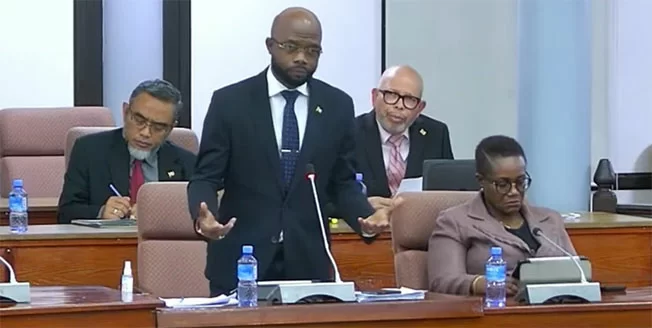
Suriname’s government has issued a grave warning about the rapidly deteriorating security situation in the country’s interior regions, with two senior ministers expressing alarm over the potential complete loss of state authority in these areas. During a tense session of the National Assembly on Tuesday, Justice and Police Minister Harish Monorath and Government Coordinator Minister André Misiekaba delivered stark assessments of the escalating criminal threats.
Minister Misiekaba delivered the most dire prognosis, stating unequivocally that ‘we risk losing control in the interior’ if immediate action isn’t taken. He described widespread lawlessness throughout gold mining regions where state presence has become virtually nonexistent. The minister further revealed the concerning presence of feared foreign criminal elements operating within Suriname’s forests, though he refrained from identifying their countries of origin.
Minister Monorath provided context to the crisis, explaining that security services currently maintain limited presence in interior regions, with police operations concentrated primarily in the eastern Lawa area and southern Saramacca region. He revealed that Suriname had received warnings seven years ago predicting that interior criminality would evolve into organized operations and eventually spread toward the capital, Paramaribo, without timely intervention. ‘These warnings are now manifesting,’ Monorath acknowledged.
The justice minister outlined structural challenges hampering effective response, citing inadequate infrastructure and severe capacity constraints. With the Suriname Police Corps comprising approximately 2,773 officers, Monorath questioned how five detachments of twelve personnel each could possibly address problems in regions where thousands of illegal weapons circulate within completely lawless environments.
The severity of the situation prompted rare unity within the National Assembly, with Assembly Chairman Ashwin Adhin suspending the session for consultations. Parliamentarians agreed to convene emergency discussions, tasking the Standing Committee for Justice and Police to collaborate with relevant ministries in developing immediate proposals. These may include thematic meetings or committee-general sessions to comprehensively address the security crisis.