Transparency advocate Jeremy Enriquez has declared the government’s response to his Freedom of Information Act request regarding Constituency Development Fund (CDF) records fundamentally inadequate. Despite previous assurances from the Office of the Prime Minister, the disclosed information fails to meet both the legal requirements and the substantive purpose of his sweeping request for accountability documentation.
The controversy originated in November 2025 when Enriquez submitted a comprehensive FOIA application seeking multi-year CDF records across multiple government ministries. The Office of the Prime Minister responded by acknowledging the administrative complexity of retrieving the extensive documentation—including budgets, disbursement records, payment vouchers, audit reports, and internal assessments—while requesting an extension beyond the statutory fourteen-day deadline for issuing an access decision.
Enriquez maintained that while he recognized the operational challenges, the government’s legal obligation to provide a formal access decision within the mandated timeframe remained absolute. He argued that administrative inconvenience cannot override statutory requirements, and failure to comply constitutes a deemed refusal, potentially triggering legal enforcement mechanisms.
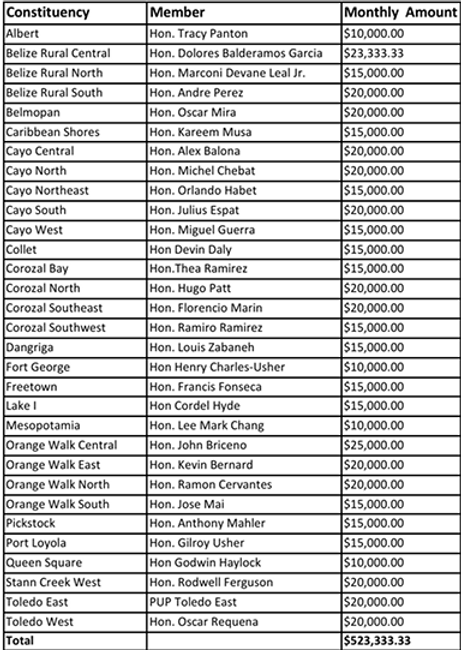
The currently disclosed information consists solely of a basic schedule outlining monthly CDF allocations by constituency, totaling $523,333.33 distributed nationwide. The breakdown reveals significant disparities in funding levels: Orange Walk Central receives the highest allocation at $25,000 monthly, while four constituencies—Albert, Fort George, Mesopotamia, and Queen Square—receive only $10,000 each.
Enriquez emphasizes that this superficial data fails to address the core objective of his request: obtaining the detailed documentation necessary to verify how funds were actually disbursed, to whom they were paid, what approval processes were followed, and whether audits revealed any irregularities or non-compliance. Without these supporting records, the public cannot effectively monitor the use of public funds or hold officials accountable for proper CDF management.
The transparency advocate has indicated that the government’s partial response represents a failure of the FOIA process’s fundamental purpose—to provide meaningful access to public records that enable genuine governmental accountability rather than merely performing transparency through minimal disclosure.