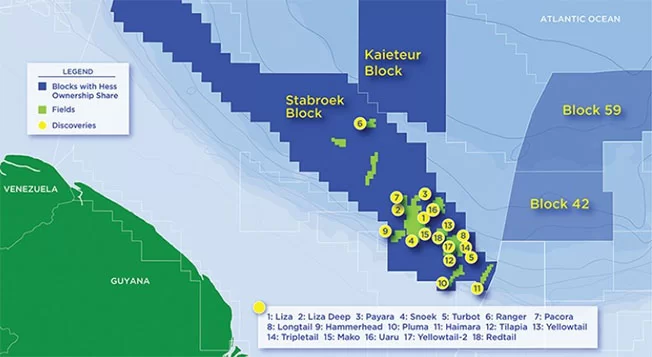
Guyana’s emerging oil economy faces a significant challenge as production data reveals the rapid depletion of its flagship Liza One and Liza Two oil fields. According to information from Guyana’s Ministry of Natural Resources, these strategic assets operated by ExxonMobil in the Stabroek Block may exhaust their recoverable reserves within just 2-3 years—dramatically shorter than the originally projected 20-year lifespan.
The Liza One field, operational since December 2019, currently holds approximately 189 million remaining barrels. With its 2025 production averaging 140,000 barrels daily (51 million annually), calculations suggest complete depletion could occur within slightly over three years. Similarly, Liza Two—commissioned in February 2022 with 266 million barrels remaining—produced at 250,000 barrels daily in 2025 (91 million annually), potentially exhausting its reserves in just over two years.
This accelerated timeline stems from production agreements between ExxonMobil and the Guyanese government that prioritized rapid extraction. However, this approach has substantially shortened the economic viability of these fields while coinciding with unfavorable market conditions. Brent crude prices have declined from approximately $100 per barrel during the 2022 Russia-Ukraine conflict to current levels around $62, with analysts warning potential further drops to $50 due to geopolitical developments including U.S. interventions in Venezuela.
Compounding these challenges, Guyana’s revenue-sharing model has limited national benefits. The absence of ring-fencing provisions allows ExxonMobil to allocate up to 75% of monthly production to recover costs from other Stabroek Block projects—a particularly disadvantageous arrangement during periods of high oil prices.
Vice President Bharrat Jagdeo previously defended this strategy, stating in October 2023 that the country was ‘sacrificing current revenues for massive future returns.’ However, the combination of rapidly depleting reserves, declining prices, and contractual terms now raises serious questions about whether Guyana will maximize benefits from its petroleum resources. The situation threatens to significantly impact funding for the national development agenda, highlighting the complex tradeoffs between accelerated extraction and sustainable resource management.