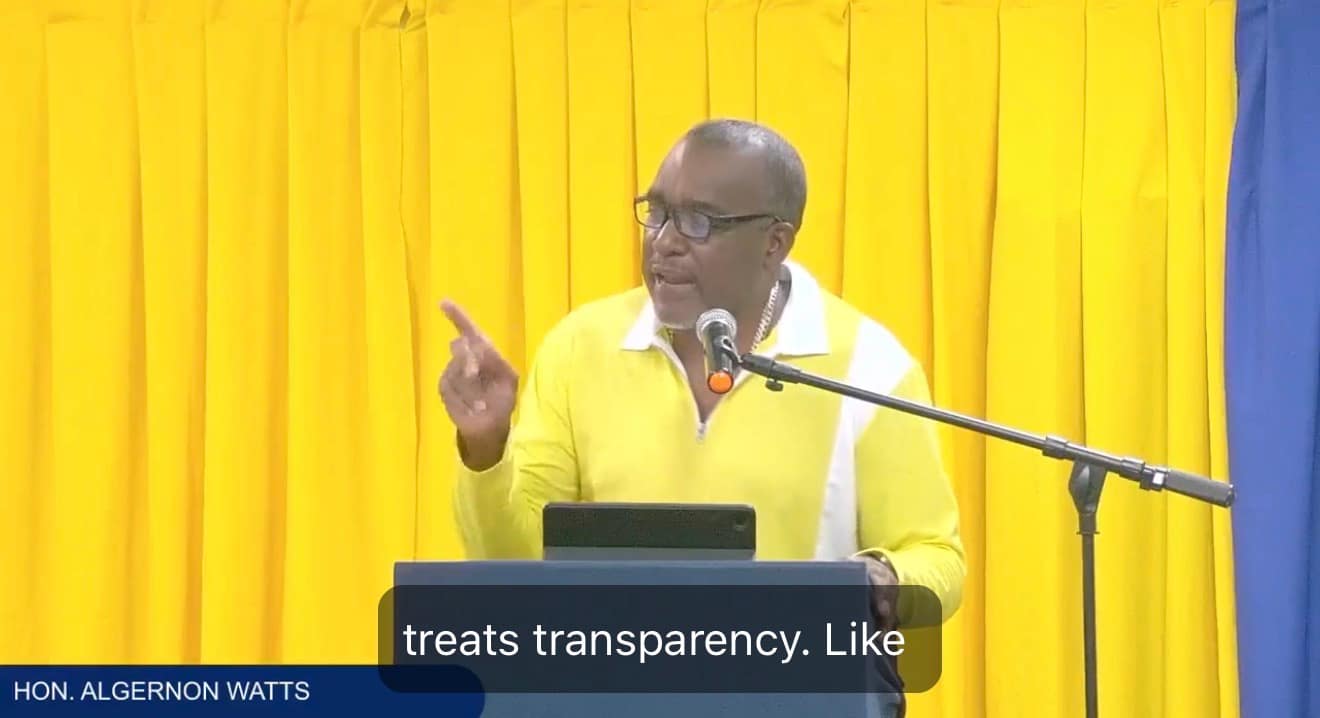
Algernon Watts, Member of Parliament for St. George, has launched a comprehensive critique of the Antiguan government’s proposed refugee and deportee arrangement with the United States, raising fundamental questions about transparency, fiscal responsibility, and national sovereignty. During a virtual rally organized by the United Progressive Party, Watts articulated multiple concerns regarding the agreement’s formulation and potential implementation.
The parliamentarian highlighted the conspicuous absence of preliminary briefings, parliamentary discourse, or public consultation before the arrangement’s disclosure. Watts emphasized that citizens only became aware of the agreement post-factum, characterizing the government’s communication as a ‘confession after the fact’ rather than transparent governance.
Watts specifically referenced the Prime Minister’s acknowledgment of months-long correspondence with the U.S. State Department, questioning why these negotiations remained concealed. ‘If you must assert something wasn’t intended to be secret, its handling inevitably suggests otherwise,’ Watts contended. ‘You cannot conceal matters and then introduce them surreptitiously.’
The MP challenged governmental assurances regarding case-by-case evaluations, an annual cap of ten individuals, and criminal exclusions, arguing that verbal commitments without written frameworks provide inadequate protection. ‘Numerical limits do not constitute strategy, and slogans cannot replace substantive safeguards,’ Watts stated. ‘Blind trust, particularly when extended to habitual prevaricators, falls short of coherent national policy.’
Watts warned that opaque decision-making erodes public trust and fosters social fragmentation, particularly within small communities. ‘When determinations occur behind closed doors, the immediate casualty is civic confidence,’ he observed. ‘This vacuum becomes filled with speculation, apprehension, and ultimately, societal division.’
The legislator posed practical questions regarding housing, medical screening, long-term healthcare, and trauma counseling for potential arrivals, questioning whether financial burdens would shift to citizens and already strained public services. ‘Without comprehensive planning, the weight falls upon ordinary citizens, overextended clinics, social workers, and communities where working-class Antiguans already struggle,’ Watts asserted.
Regarding accountability, Watts questioned responsibility protocols for potential mishaps, noting that consequences would manifest locally rather than in Washington. He further cautioned about precedent-setting implications, suggesting that initial limits could expand without public consent through exception proliferation.
Connecting to broader bilateral concerns, Watts referenced recent U.S. visa restrictions and proposed bond requirements affecting Antiguans, juxtaposing these with the current arrangement’s potential pressures. He demanded full disclosure of draft memoranda, legal authority, cost allocations, and administrative responsibilities, while urging written commitments against cap expansion without parliamentary approval and public consultation.
Watts clarified that his position reflects pro-national interest rather than anti-migrant sentiment, concluding: ‘Antigua and Barbuda constitutes neither warehouse nor storage facility. Cooperation must be predicated on earned consent through governance conducted in daylight, not secrecy.’