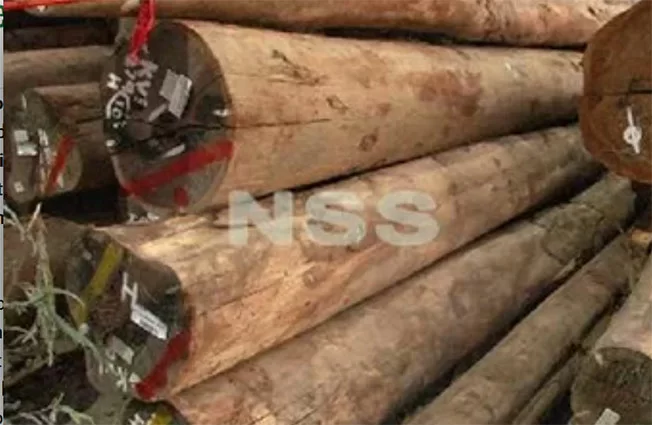
A controversial court ruling in Suriname has compelled the state to issue phytosanitary certificates for timber shipments that demonstrably contradict their declared contents, creating both legal and administrative turmoil. Presiding Judge Robert Praag’s decision explicitly permits international non-compliance despite available alternatives, prioritizing economic interests over regulatory integrity.
The judgment reveals the court’s awareness of the core issue: the certificates do not match the actual shipments. This represents not merely an interpretive discrepancy or administrative oversight, but objectively incorrect documentation. Nevertheless, the state must now issue these certificates under penalty of a SRD 1 million per hour fine.
Historical context demonstrates this is not a sudden development. As early as August 2022, previous leadership at the Ministry of Agriculture, Livestock and Fisheries (LVV) and the National Plant Protection Organization (NPPO) identified systematic export of different wood species under the trade name ‘Mora roundlogs’ to India, violating both international phytosanitary regulations and India’s explicit import requirements. Internal correspondence shows the technical authority (NPPO) opposed issuing certificates for incorrect shipments, with international partners explicitly rejecting a proposed six-month ‘grace period’ in 2022.
The court had several legally defensible alternatives: upholding international obligations as paramount, redirecting economic damages to civil proceedings against the state for years of failed policy, or providing temporary relief without legitimizing incorrect documentation. Instead, the ruling accepts the factual inaccuracy of the certificates based on the argument of irreversible economic damage.
This decision shifts the burden of years of failed governance onto the technical integrity of the NPPO, Suriname’s international reputation, and its relationship with India. Phytosanitary certificates represent legal-international instruments rather than commercial documents, making deliberate issuance of incorrect documentation institutional falsehood rather than pragmatism.
India’s perspective differs significantly from Suriname’s internal discussions. Indian authorities have repeatedly clarified that trade names are insufficient, only correct botanical names are permitted, and deviations are unacceptable regardless of internal problems in exporting countries. A national court ruling does not alter these requirements.
The judgment has postponed rather than resolved the underlying issue. While exports remain largely on hold and inventories accumulate, the core problem persists: structural non-compliance cannot be normalized through judicial order. The LVV ministry has complied with the ruling under protest while simultaneously filing an appeal, recognizing that in a constitutional state, law should never be exchanged for convenience—not even once.