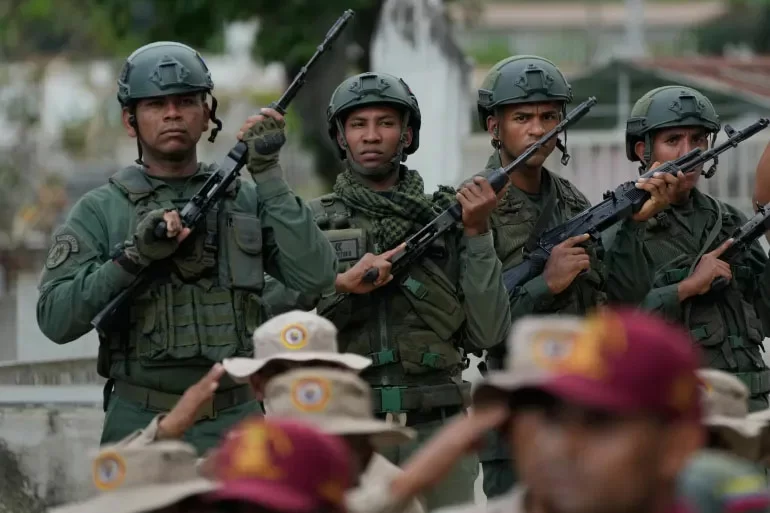
Following the dramatic capture of Venezuelan President Nicolás Maduro by U.S. special forces, the Bolivarian National Armed Forces (FANB) confronts a pivotal moment that will determine Venezuela’s political future. The military operation, which extracted Maduro from Fort Tiuna—the nation’s largest military complex—has exposed significant vulnerabilities in Venezuela’s defense capabilities and created a power vacuum that demands strategic decision-making.
For nearly three decades, the FANB served as the primary power broker for the Chavez and Maduro regimes, receiving extensive political appointments including ministerial positions, governorships, and control over state enterprises in exchange for enforcing authoritarian rule. This symbiotic relationship transformed Venezuela into a security state where military authority superseded civilian institutions.
The current interim government under Delcy Rodríguez, despite enjoying support from the Trump administration, requires military backing to maintain stability. President Trump’s selection of Rodríguez over opposition leader María Corina Machado reflects calculated recognition that only a candidate acceptable to military leadership can navigate this transition.
Military commanders now face compelling incentives to negotiate: the demonstrated superiority of U.S. military technology creates vulnerability to further interventions, while maintaining political influence requires accepting previously unthinkable concessions. These include distancing from narcotrafficking allegations, accepting U.S. energy companies’ control over Venezuelan oil resources, reducing repression of civilian populations, and fully supporting Rodríguez’s interim government.
The military’s cooperation essentially means endorsing U.S.-Venezuela agreements that would establish a stabilization framework similar to American partnerships with military regimes in Egypt, Pakistan, and Thailand. Resistance risks triggering additional U.S. military actions that would further erode the military’s credibility and exacerbate Venezuela’s political and social instability.
With limited options, the FANB’s leadership must choose between preserving some political influence through cooperation or facing complete marginalization through confrontation. Their decision will ultimately determine whether Venezuela’s transition occurs through negotiation or continued conflict.