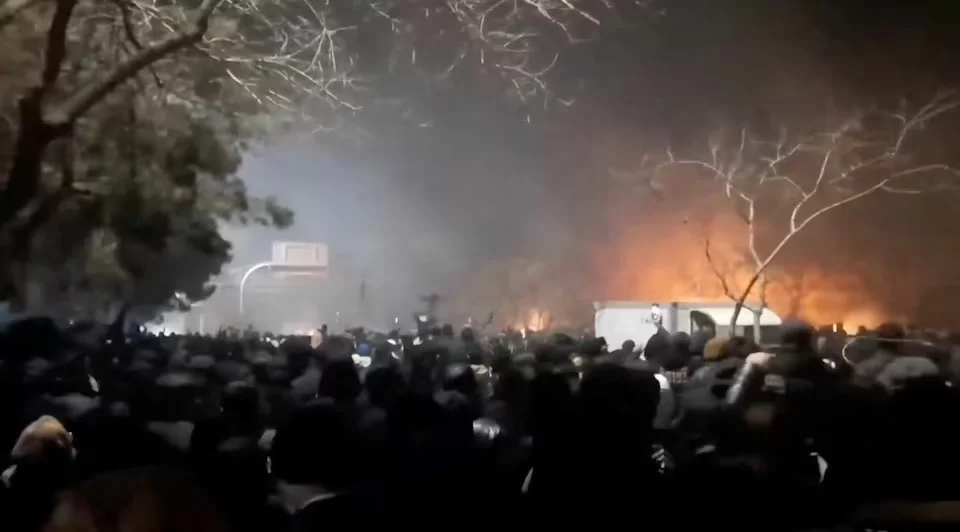
Iran’s political leadership issued stark warnings on Sunday, threatening military retaliation against American bases and Israeli territories if provoked, as the nation grapples with its most significant anti-government demonstrations since 2022. Parliamentary Speaker Mohammad Baqer Qalibaf, a former Revolutionary Guard commander, declared that “occupied territories (Israel) and all US bases and ships will become our legitimate targets” in response to any external attack.
The unrest originated on December 28th as economic protests against soaring prices but has rapidly evolved into direct opposition against the clerical establishment that has ruled since the 1979 Islamic Revolution. Iranian authorities have accused the United States and Israel of instigating the turmoil, with Police Chief Ahmad-Reza Radan confirming intensified security operations against what he termed “rioters.
Human rights organization HRANA has documented 116 fatalities, primarily protesters but including 37 security personnel, though comprehensive verification remains challenging due to government-imposed internet restrictions. State television broadcast footage of dozens of body bags at a Tehran morgue, attributing the casualties to “armed terrorists” allegedly responsible for the violence.
Israeli security officials confirmed elevated alert status amid potential US intervention scenarios, while maintaining that the protests represent an internal Iranian matter. The military establishment stated readiness to respond “with force if necessary” while monitoring developments defensively.
The protests occur against a complex geopolitical backdrop, with Iran still recovering from last year’s twelve-day war with Israel that involved brief US intervention targeting nuclear facilities. Regional analysts note Tehran’s weakened position following setbacks to allies like Hezbollah since Hamas-led attacks on Israel in October 2023.
President Masoud Pezeshkian utilized a televised interview to frame the unrest as foreign-engineered destabilization, pleading with families to prevent youth participation with what he characterized as “terrorists who behead people and kill others.” Simultaneously, he promised governmental willingness to address economic grievances.
Social media circulated videos showing substantial nighttime gatherings in Tehran’s Punak district, where protesters drummed on bridge railings and metal objects in apparent defiance, while other footage captured massive crowds marching through streets with synchronized chanting. State television counter-programmed with funeral processions in western cities for security forces killed during the unrest.