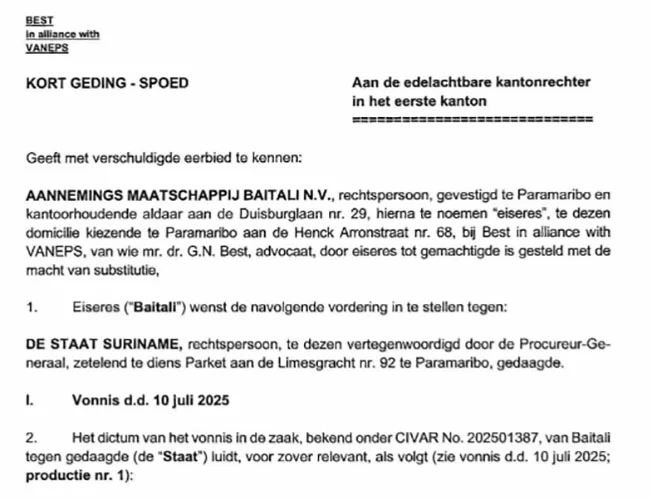
Baitali NV has initiated another legal proceeding against the Republic of Suriname regarding the Van ‘t Hogerhuysstraat infrastructure project controversy. The company filed a petition requesting the court to compel the State, specifically the Ministry of Public Works, to enforce a previous judicial verdict that favored the construction firm.
The initial ruling by the cantonal court mandated that the tender process for infrastructure work on Van ‘t Hogerhuysstraat must be reevaluated and reopened for bidding. This judgment explicitly required that Baitali be granted the opportunity to participate in the renewed tender process.
According to company director Farsi Khudabuks, despite the judgment becoming irrevocable several months ago, the Surinamese government has failed to implement the court’s decision. “The verdict was pronounced with an execution deadline of two days, yet six months have elapsed without any action,” Khudabuks stated in an interview with Starnieuws. The company asserts that authorities have provided no clear explanation for this prolonged non-compliance.
The case took a complex turn when the Inter-American Development Bank (IDB) initially threatened to withdraw project funding if the court ruling was implemented. However, Khudabuks revealed that the IDB later moderated its position during a high-level visit to Suriname. The bank’s president reportedly assured Suriname’s leadership that as a “law-abiding organization,” the IDB respects judicial decisions within member countries.
“This development removed any potential obstacles for the State to simply execute the court order,” Khudabuks emphasized. Despite this clarification, implementation remains stalled, prompting Baitali to seek judicial intervention once more.
In the renewed legal action, the company is petitioning to increase the imposed penalty from SRD 5,000 per day, arguing the current amount proves insufficient to motivate compliance. “Apparently this sum isn’t substantial enough to persuade the State to fulfill its legal obligations,” Khudabuks noted, while stressing that financial penalties serve as legal pressure mechanisms rather than primary solutions.
The director underscored that settlement negotiations are not being considered: “There exists a court verdict that must be executed. This isn’t a matter of negotiation or compromise—the rule of law must prevail.” The company anticipates a new court hearing shortly to address its enforcement petition.