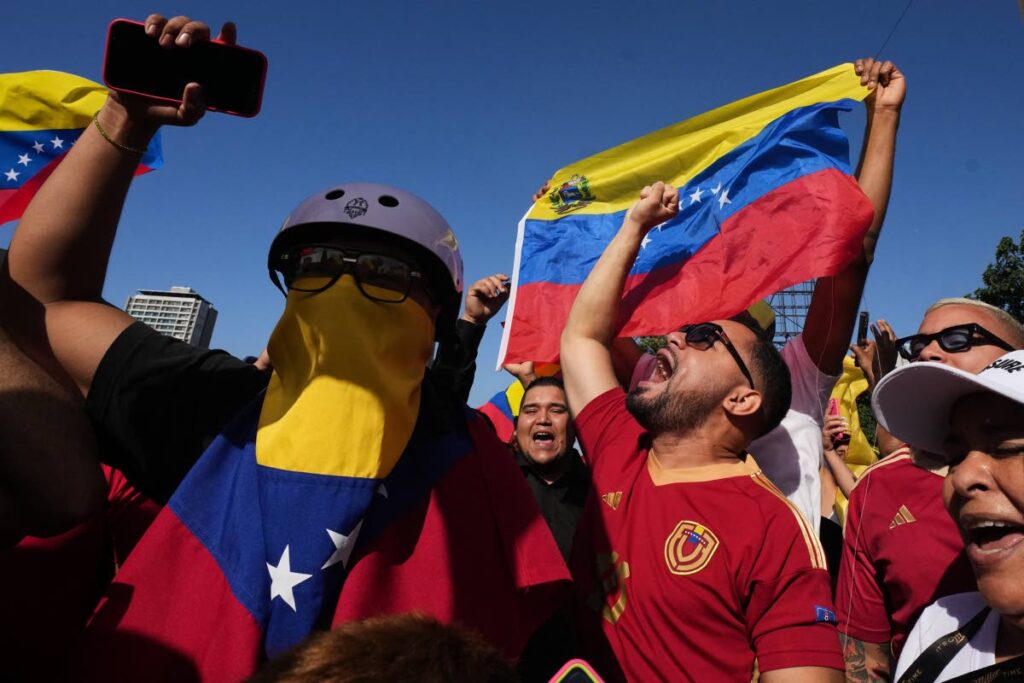
The Venezuelan diaspora in Trinidad and Tobago has responded with both celebration and concern following the unprecedented US military operation that resulted in the capture and removal of President Nicolás Maduro on January 3rd. US President Donald Trump confirmed at a Mar-a-Lago press conference that a “large-scale strike” had been executed, resulting in Maduro and his wife being transported to the United States to face criminal charges.
Trump announced that the United States would temporarily administer Venezuela through an unspecified group while explicitly stating his intention to access the country’s substantial oil reserves. He outlined plans for US oil companies to invest billions in rebuilding Venezuela’s energy infrastructure with the goal of exporting “large amounts of oil to other countries.”
Former photojournalist Grevic Alvarado expressed cautious optimism, describing Maduro’s removal as “the first step towards freedom” while acknowledging concerns about family members remaining in Venezuela. “We are hopeful, but at this moment we need to understand what is happening,” Alvarado stated, emphasizing the need for calm until more information becomes available from US authorities and Venezuelan opposition leaders María Corina Machado and Edmundo González.
Human rights activist Yesenia González characterized the development as “a very happy and emotional day” for Venezuelans who have endured years of economic collapse, shortages of basic necessities, and political repression. While not celebrating violence, she expressed hope for national renewal, institution rebuilding, and the eventual return of millions of displaced Venezuelans.
González specifically thanked Trinidadian Prime Minister Kamla Persad-Bissessar for supporting US actions and praised Trump’s leadership, asserting that a “free, stable and democratic Venezuela” would benefit both Venezuelans and the broader region by reducing forced migration and fostering cooperation.
However, dissenting voices emerged from within Venezuela. Political analyst Jesús Enrique Rojas described the atmosphere as “tense” following what he called a “big surprise” that sparked widespread indignation. Rojas reported civilian and military casualties from the strikes and emphasized that neither the public nor Vice President Delcy Rodríguez knew Maduro’s precise whereabouts or condition.
Rojas condemned the operation as a violation of international law and Venezuelan sovereignty, warning that installing an opposition figure like Machado could trigger civil war. He insisted that constitutional protocols must be followed, with Vice President Rodríguez assuming leadership pending Maduro’s return or a Supreme Court decision regarding new elections.
The professor called for unified action among Venezuelans to restore their democratically elected leader and normalcy to the nation, asserting that “We decide who is going to be our President because we have our own laws.”