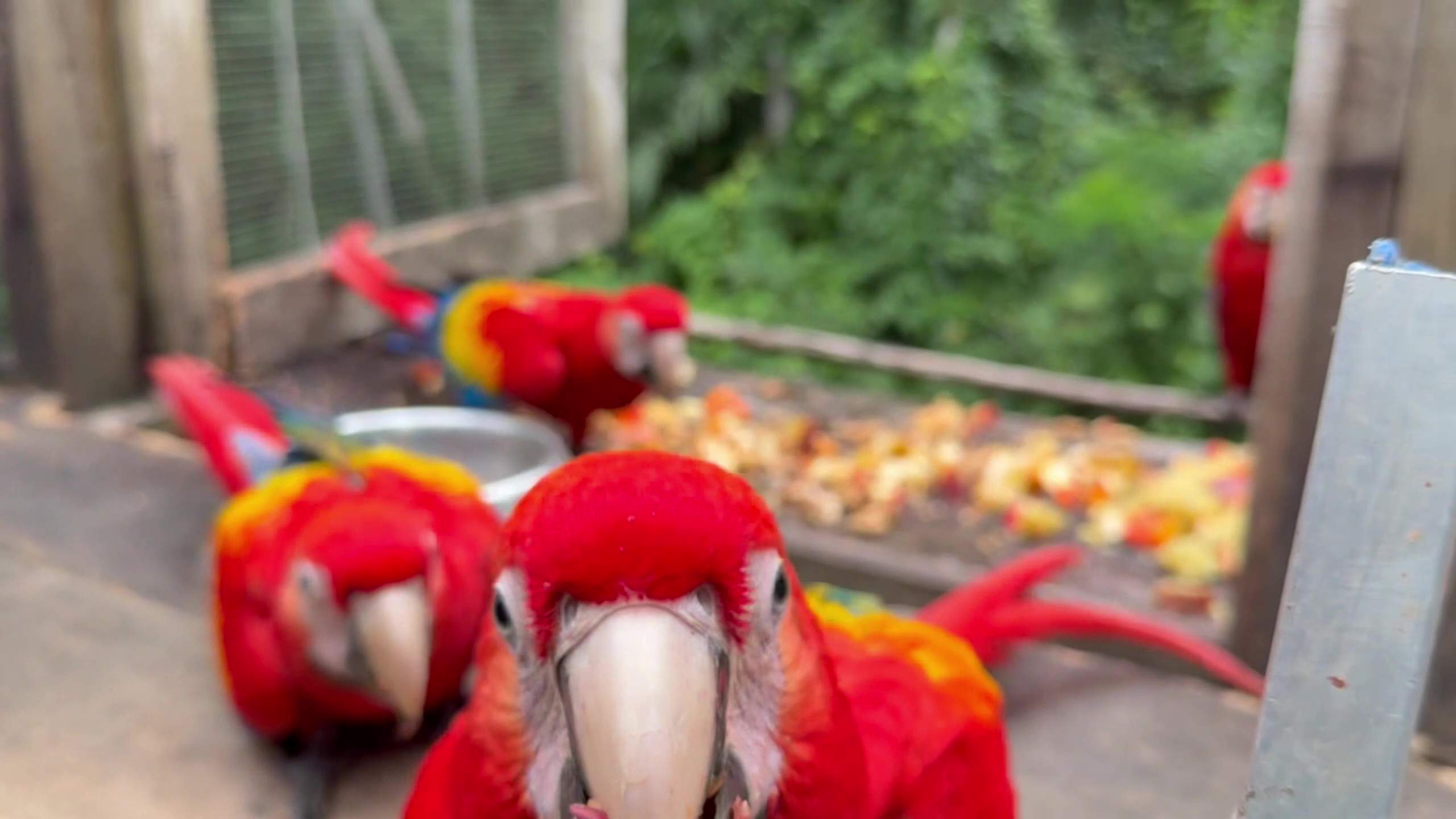
Deep within Belize’s Chiquibul rainforest, a dramatic conservation battle unfolds as endangered Scarlet Macaws face relentless poaching threats despite showing promising population recovery signs. According to Friends for Conservation and Development (FCD), Belize’s national Scarlet Macaw population now stands at approximately 300-350 birds, with current nesting season data revealing encouraging trends.
The 2025 nesting season documented 23 active scarlet macaw nests with 70 eggs laid. Conservationists recorded a 60% hatching success rate, with 42 chicks successfully hatched, while 6 eggs were lost to predation and 16 failed to hatch. Six eggs remain under incubation as monitoring continues.
However, these conservation achievements are undermined by sophisticated poaching networks operating across the Belize-Guatemala border. Guatemalan poachers undertake grueling 2-3 day journeys into Belizean territory, scaling 50-70 foot quamwood trees to extract chicks before they fledge. The birds’ vibrant red, blue, yellow, and green plumage, combined with their loud vocalizations and social nature, make them easily detectable targets.
The illegal wildlife trade drives this poaching epidemic, with individual Scarlet Macaws commanding prices up to $15,000 USD on the black market. Traffickers supply both local collectors and international markets, with birds increasingly destined for Asian buyers who offer $50-100 per egg. This transnational crime network contributes to the global illegal wildlife trade, estimated at $23 billion annually.
Conservation efforts face additional challenges as poachers constantly adapt their methods. While previous poaching involved shooting adult birds, current tactics focus on chick extraction and egg collection. Some buyers now prefer eggs for artificial incubation, creating new market demands.
Despite these threats, collaborative conservation initiatives show promise. FCD continues its monitoring program under a renewed two-year license, with support from Belize’s Forest Department and Bulridge Company Limited. Regional organizations including Asociación Balam and WCS Guatemala are working to combat trafficking networks and raise enforcement capabilities across Central America.
Belize’s Minister of Sustainable Development Orlando Habet emphasized government support for these conservation partnerships, noting knowledge exchange and wildlife rehabilitation programs are strengthening protection efforts. Yet conservationists warn that without sustained intervention and improved cross-border enforcement, the Scarlet Macaw’s recovery remains precarious in the face of organized poaching operations.