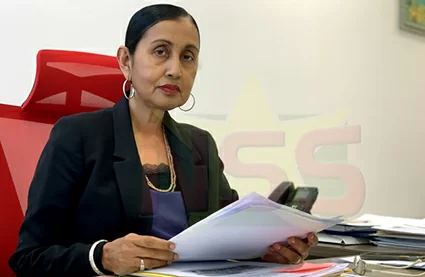
Suriname’s judicial system faces mounting tension as Prosecutor General Garcia Paragsingh has publicly denounced the government’s exclusion of the Public Prosecution Service from legislative processes directly affecting its operations. The controversy stems from two recently proposed laws that would fundamentally reshape the nation’s prosecution apparatus, including the establishment of a College of Prosecutors General.
In an unprecedented rebuke, Paragsingh revealed that the Public Prosecution Service learned about these significant judicial reforms through media reports rather than official channels. She characterized this exclusion as “unheard of and incompatible with democratic constitutional principles,” describing the government’s approach as imposing and even dictatorial in nature.
The proposed College of Prosecutors General has drawn particular criticism. Paragsingh questioned whether proper preliminary research was conducted regarding the prolonged duration of court cases, emphasizing that her office bears no responsibility for delays once cases reach trial proceedings. “The role of the Public Prosecution Service as dominus litis ends when the case is called to session by the bailiff,” she stated, noting that prosecutors lose all control over case duration once proceedings begin.
Additional concerns were raised regarding plans to lower the retirement age for prosecutors to 65 while maintaining a 70-year retirement threshold for the President and members of the Court of Justice. Paragsingh challenged this discrepancy, questioning why the Prosecutor General—who is similarly affiliated with the Court of Justice—should not receive equal treatment.
The Public Prosecution Service emphasized that careful governance requires consulting relevant institutions and stakeholders before implementing legislation that directly affects them. The organization expressed profound dismay at learning about these consequential reforms through a press conference, with Paragsingh asserting that such procedures violate fundamental democratic principles.