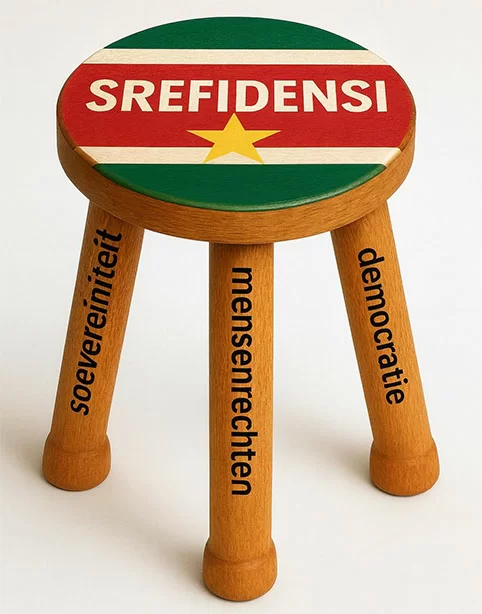
Fifty years ago, Suriname embraced ‘Srefidensi’ – the poetic creation of writer Trefossa – as the name for its hard-won independence. This concept represented not just constitutional and international sovereignty, but the rebirth of a democratic nation founded on the rule of law. The unanimously adopted constitution guaranteed elections, independent judiciary, separation of powers, and fundamental rights, establishing what became known as the three pillars of Srefidensi: sovereignty, democratic governance, and human rights.
This foundation was violently shattered on February 25, 1980, when a bloody military coup severely violated the constitution. Two of the three pillars were systematically dismantled: democratic governance and human rights. The young republic lost its essential foundation for peaceful coexistence, replacing it with the law of the strongest. The introduction of murder and torture as political instruments led to grave human rights violations, crimes against humanity, and civil war that would claim countless Surinamese victims.
Statistical analysis reveals the devastating scale: when comparing death tolls from state violence under Suriname’s military dictatorships (1980-1987/1990-1991) with Brazil’s military regime (1964-1985) – adjusted for population size – Suriname’s rate was 230 times higher, achieved in a much shorter timeframe.
The concept of ‘srefidenki’ – discovered in Trefossa’s pre-independence notebooks and described by music educator Mavis Noordwijk as representing emancipatory, autonomous thinking – flourished despite oppression. For 50 years, courageous critical thinking persisted across journalism, law, labor unions, education, science, politics, music, literature, and arts. This intellectual resistance addressed colonialism, patronage systems, dictatorship, inequality, and discrimination.
Recent attempts by political leadership to co-opt the term ‘srefidenki’ as representing a new phase of development constitute what analysts describe as ‘vocabulary of historical denial.’ The state’s appropriation of this freedom-concept has raised anti-authoritarian suspicions, as srefidenki fundamentally represents critical citizenship rather than government-endorsed ideology.
The dictatorship’s brutality peaked in December 1982 when military forces torched two radio stations, the largest union center, and a newspaper printing press while preventing firefighting efforts. Independent media faced publication bans, and all permitted outlets operated under strict censorship. The destruction of platforms for free thought failed to satisfy totalitarian hunger for power. Fifteen prominent advocates of Surinamese democracy were tortured and executed. By May 1983, free elections were officially abolished from government policy, with the Netherlands declared ‘Enemy Number One.’
Today, Surinamese citizens and international supporters gather at memorials in Amsterdam and Fort Zeelandia’s National Monument Bastion Veere to honor those who made the ultimate sacrifice for democracy and human rights, including the right to srefidenki. A landmark 2023 appellate judgment definitively rejected long-standing false narratives that victims were ‘shot while fleeing’ or involved in ‘coup and invasion’ plots.
As Suriname reflects on 50 years of independence, building a prosperous and just future requires acknowledging the creation, collapse, and restoration of Srefidensi’s three pillars. Only through this reckoning can the nation consolidate and strengthen the moral foundation necessary for genuine democratic existence.