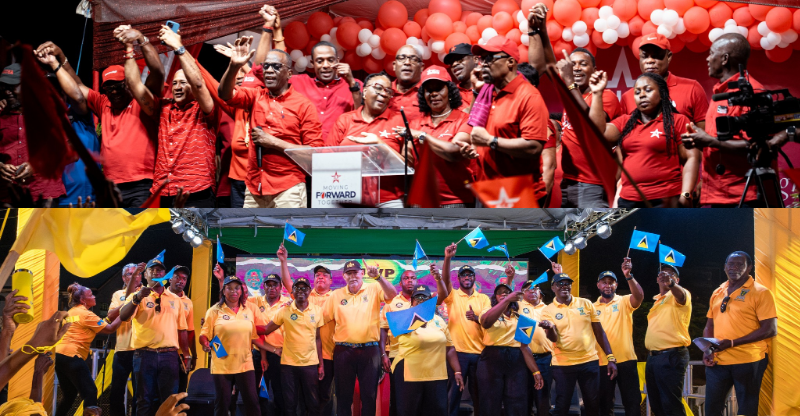
The commencement of Saint Lucia’s 2025 general election campaign triggered a 21-day period of intensified political engagement characterized by aggressive messaging, heated debates, and a notable deterioration into personal attacks. The nation’s political landscape, shaped by a winner-take-all electoral system and a deeply adversarial political culture inherited from Westminster, created an environment where personal vilification frequently overshadowed policy discussions.
Professor Cynthia Barrow-Giles, a distinguished Saint Lucian political scientist, had presciently analyzed this dynamic in her 2010 publication ‘Democracy at Work: A Comparative Study of the Caribbean State.’ Her examination of how electoral systems and political culture shape regional democracy remains remarkably relevant fifteen years later. She argued that this combination inevitably produces “high-stakes elections, skewed parliaments, and a style of politics where personal attacks often overshadow policy.”
Despite superficial assessments describing the 2025 campaign as proceeding “smoothly,” the rhetorical landscape revealed a different reality. Charges of “corruption,” “criminal” behavior, and being “unfit for office” dominated political discourse across platforms. Particularly disturbing were at least two pro-UWP campaign songs that derogatorily referred to Prime Minister Philip J Pierre as “autistic” and “retarded,” language that sparked cross-party outrage and drew condemnation from advocacy groups including the Helen Association for Persons with Autism.
The targeting extended beyond political figures to their families. UWP’s Vieux Fort North candidate Calixte Kakal Xavier found himself defending attacks directed at his partner and son rather than addressing policy issues. Female candidates from both major parties faced gender-based questioning rather than evaluations of their competence. Former Prime Minister Allen Chastanet continued to face racially-charged criticism with his “whiteness” routinely used as shorthand for foreignness.
Significantly, the most virulent attacks frequently originated not from the candidates themselves but from party surrogates, supporters, and unofficial mouthpieces operating outside formal party messaging structures. This phenomenon of “unregulated actors” shaping campaign tone without accountability, as noted by Barrow-Giles, represents a regional pattern in small states’ political cultures.
The Saint Lucia Labour Party (SLP) centered its campaign on governance achievements, with Prime Minister Pierre emphasizing his administration’s “record” while explicitly rejecting participation in “roro” (local vernacular for rhetorical excess). The party maintained consistent messaging around continuity and stability, bolstered by former UWP figures including Andy Daniel, Edmund Estephane, and Felix Champagne Deterville, who appeared on Labour platforms to condemn UWP leadership, providing the strategic advantage of insider criticism.
The United Workers Party (UWP) mounted a campaign fueled by large rallies, promises of renewal, and sharp critiques of the Labour administration. Their messaging focused on accusations of mismanagement, rising living costs, and failures in healthcare and law enforcement. A cornerstone of their strategy involved introducing twelve new faces, many political newcomers, which regional pollster Peter Wickham described as an “impressive” rebuild following the party’s devastating 2021 defeat.
However, this infusion of new talent presented challenges when several candidates faced backlash for controversial remarks. Tommy Descartes’s comment that “gangsters are yellow” and Stephen Fevrier’s remarks about auctioning Olympian Julien Alfred’s shoe required subsequent withdrawals and clarifications, illustrating the tension between political spectacle and substance that Barrow-Giles identified in Caribbean electoral competitions.
With the election concluded and Prime Minister Pierre preparing to form his new Cabinet, public exchanges have notably diminished. Candidates across the political spectrum have thanked their teams, exchanged congratulations, and acknowledged voter efforts. As the new administration takes shape, attention is expected to shift toward governance and policy, though discussions about campaign rhetoric and its implications for democratic discourse will undoubtedly continue.