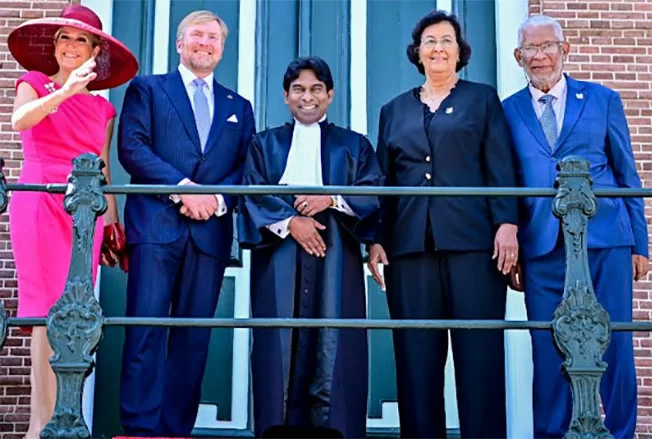
In a landmark engagement during their state visit to Suriname, King Willem-Alexander and Queen Máxima of the Netherlands were granted an unprecedented insight into the operational realities and systemic pressures facing the Caribbean nation’s judicial system. The Monday visit to Suriname’s Court of Justice, described by legal experts as “historic,” featured frank discussions about the state of justice administration and the mounting challenges confronting the judiciary.
Acting Court President Iwan Rasoelbaks welcomed the royal delegation with a message that balanced national pride with sobering honesty. He emphasized that Suriname’s conscious choice for a democratic constitutional state in 1975 remains unwavering, with judiciary operations continuing to be grounded in principles of independence, impartiality and integrity. However, he openly acknowledged that “the pressure is immense and capacity remains limited.”
The institution handles an extensive annual caseload of civil and criminal matters with merely 31 judges supported by just over 270 court staff members. This structural shortage has created significant case backlogs that directly impact both citizens and legal professionals.
In response to these constraints, Suriname has initiated an intensive judicial training program (RAIO) in collaboration with the Netherlands. Eleven new judges are anticipated by early 2026—representing the first phase toward achieving the target of 57 judges by 2027, which the Court identifies as the minimum capacity required to manage its workload effectively.
Rasoelbaks further highlighted another chronic challenge: geographical inequality in access to justice. First instance proceedings are currently only conducted in four districts, forcing residents from other regions to travel to Paramaribo for legal proceedings. While digital justice solutions could potentially address this disparity, satellite connections remain prohibitively expensive and technically unstable.
King Willem-Alexander, participating actively in the discussions with evident preparation, posed pointed questions regarding equal access to justice. He inquired how rights are guaranteed for citizens unable to afford legal representation and how the system prevents legally inexperienced individuals from being disadvantaged against professional parties.
Rasoelbaks referenced existing provisions for free legal aid and emphasized that criminal defendants always have access to defense counsel. Nonetheless, he conceded that further expansion of these services remains necessary to ensure genuine equality before the law.
The conversation also addressed technological deficits within the judicial system. The monarch questioned what alternatives exist when justice administration in remote regions remains dependent on physical hearings in Paramaribo. The court president outlined both the potential and financial constraints of technological solutions.
Notably, King Willem-Alexander explicitly referenced the December Murder trials, stating that the process had “confirmed the strength of the independent judiciary.”
President Jennifer Simons concluded the visit with a definitive message: Suriname continues to work toward strengthening its constitutional state, including the future implementation of cassation jurisdiction. She indicated that these efforts build upon ongoing discussions maintained for years with partners including the Netherlands and the Caribbean Court of Justice. “The judiciary faces significant pressure, as the court president clearly explained,” she stated. “But we are working toward reinforcement. This process continues undiminished.”