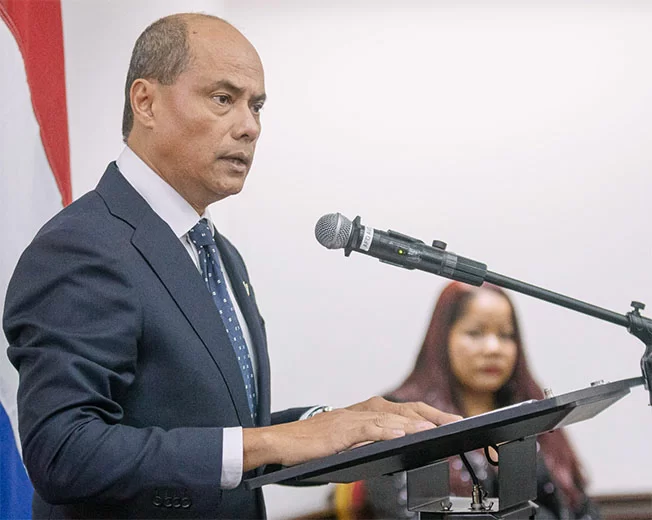
Suriname’s National Party of Suriname (NPS) faction leader Jerrel Pawiroredjo has issued a forceful critique of the Netherlands’ visa policies toward Surinamese citizens, characterizing the current treatment as a persistent diplomatic concern that strains bilateral relations. The remarks were delivered Monday during an extraordinary public assembly attended by the Dutch royal couple.
Pawiroredjo commenced his address by warmly welcoming King Willem-Alexander and Queen Máxima, acknowledging the profound linguistic and historical ties binding the two nations through a colonial history spanning over three centuries. While recognizing this shared past contains dark chapters, the parliamentarian noted it had ‘unintentionally laid the foundation for Suriname’s beautiful, diverse contemporary society.’
The statesman then pivoted to what he described as matters requiring concrete action rather than rhetorical diplomacy: mutual respect and equality. ‘The treatment of our citizens during visa application procedures remains an enduring concern,’ Pawiroredjo asserted. He detailed how Surinamese applicants face exhaustive questioning while Dutch financial guarantors must disclose comprehensive personal financial information—a contrast he found particularly striking compared to larger South American nations whose citizens enjoy visa-free travel despite lacking historical ties with the Netherlands.
The NPS leader simultaneously acknowledged decades of Dutch support across multiple sectors, specifically highlighting collaborative efforts in education, healthcare innovation, climate change mitigation, water management systems, and agricultural technology as areas ripe for continued partnership development. Pawiroredjo also expressed appreciation for the Netherlands’ formal apologies for historical slavery, suggesting the relationship should now progress forward-looking. ‘Let a positive vision for the future become our shared compass,’ he concluded, expressing hope that bilateral relations would deepen further for ‘the glory of both living communities.’